
The phrase Mona Lisa smile designates an enigmatic, mysterious smile, reminiscent of that represented in the Mona Lisa.
Mona Lisa is the name in English of a portrait painted (1503?-1507?) by the Italian artist, architect and engineer Leonardo da Vinci (1452-1519). This name is from Italian Monna Lisa (del Giocondo), the name of the portrayed woman, wife of Francesco del Giocondo. This portrait is called La Gioconda in Italian, La Joconde in French.
—Cf. also L H O O Q (i.e., she is hot-arsed), by the French artist Marcel Duchamp (1887-1968):
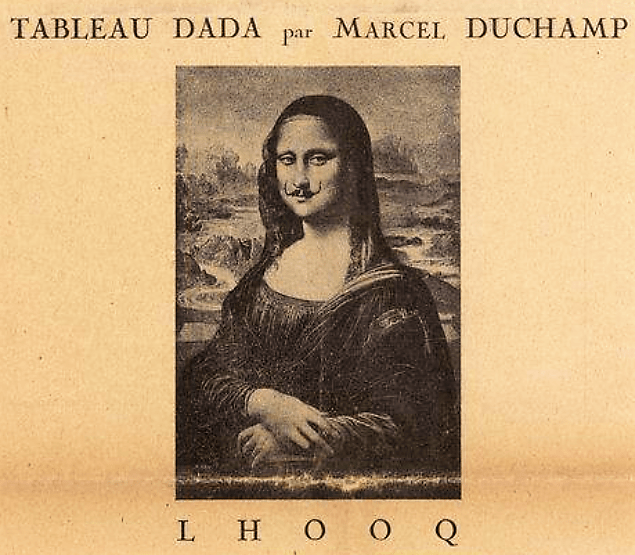
The earliest occurrences of the phrase Mona Lisa smile that I have found are as follows, in chronological order:
1-: From The Talk of New York, published in The Brooklyn Daily Eagle (Brooklyn, New York, USA) of Sunday 19th February 1888 [Vol. 48, No. 49, page 15, column 2]:
There is a mystery at the Metropolitan Opera House which for two years has afforded me occupation in spare moments in the endeavor to guess the meaning of it. In a certain box, night after night, have appeared three persons. […] On the right, commanding a view of the whole house, sits a very young woman, with a face like Leonardo da Vinci’s famous “Mona Lisa.” It has the same long dreamlike eyes and slow subtle smile. […] This girl never seems to speak. She gazes dreamily at the stage sometimes, but it evidently possesses no interest for in the midst of the most thrilling denouements she turns indifferently away and lets her look wander anywhere. Opposite her sits another woman a few years older, who is always robed in black lace. […] Back in the shadow of the curtains the third occupant is dimly seen to be a large, dark man, who scarcely moves at all and only at long intervals speaks to his companions. They bow to no one, no one notices them. Once in a while a man visits them, but it is invariably a stranger, whom I have never seen before. He never stays long and conversation seems to flag. The elder woman talks to him without animation or smiles, while the younger one never speaks at all and gazes as if off into unmeasured space always with her same fixed Mona Lisa smile and dark dreamless eyes. I can make nothing of them though I have lain awake nights making romantic stories to fit these curious facts.
2-: From The Harvard Advocate (Cambridge, Massachusetts, USA) of Monday 22nd January 1894 [Vol. 56, No. 7, page 111, column 2]—The Harvard Advocate is the art and literary magazine of Harvard College, the undergraduate college of Harvard University, Cambridge, Massachusetts:
A CONVERSATION.
Scene: A room in Claverly Hall, brilliantly furnished with electric lights and a wainscoting. There are—incidentally—other things in the room. Two of them are men. The whole scene—le toot enscramble, as one says in French—impresses one with the fact that the owner of the room is being educated at considerable expense.
Time: Eleven P. M.
One of the Men, ’95 (an intelligent looking person with a Mona Lisa smile). This is very pleasant and all that—but I must go. (He lights a fresh cigarette and sinks back amid cushions.)
The Other Man, ’96 (with sincere sincerity). Oh, please don’t go.
One , ’95. I’m wasting such a lot of time.
The Other, ’96. By Jove! you’re frank about it.
3-: From Hit or Miss. Little Bits of Chat Concerning Players and Plays, published in The Detroit Free Press (Detroit, Michigan, USA) of Sunday 29th September 1907 [Vol. 73, No. 4, Part 4, page 11, column 2]:
A new type of adventuress has been introduced into melodrama by Wymond Carey in his novel “Love the Judge”—the young woman who has been four years at Girton, who reads Euripides at her toilet and combines with the “enigmatic” Mona Lisa smile a genius for operations on the Stock Exchange. She makes a curious and characteristic bid for the hero’s affections with intellectual blandishments.
4-: From The Cobbler (New York: The Outing Publishing Company, 1908), a novel by Elma Allen Travis (1861-1917):
[page 7]: Miss Farrington’s dreamy, nearsighted eyes were an optical illusion; she was not addicted to dreams of any sort. Smiling faintly, almost imperceptibly—a mystic, Mona Lisa smile—she stepped near Peter and lightly laid her hand upon his breast.
[page 51]: “Do you wish to be rid of me? I will stay out at college till I finish, if you do. The cottage is too small for my effects,” his daughter told him with her Mona Lisa smile.
[page 73]: The Mona Lisa smile was on her lips and eyes when she told Peter how Sir Archibald had proposed that they should work together all their lives.
[page 113]: The mystic Mona Lisa smile of private amusement flitted across her still lips.
[page 243]: Elizabeth, as usual, took cognizance of concrete facts and their reassurance brought the old Mona Lisa smile to her lips.
[page 285]: Her stateliness could not disguise her solicitude and Peter immediately began teasing her about it, in a way which brought the Mona Lisa smile to her calm lips.
5-: From The Review of Reviews (London, England) of April 1909 [Volume 39, No. 232, page 363, column 1]:
SARAH BERNHARDT’S EYES.
In a character study in Cassell’s of the famous actress by Jean Victor Bates occurs this description of her eyes:—
The immortality of her spirit flashes out so brilliantly from her eyes that the mortal is obscured. Heedless of time and suffering, the light from the soul behind shines out through its mask. It is this inward fire that gives such a dazzling, subtle sweetness to “the Mona Lisa smile” of her thin, red lips, parted over her white teeth. It is this fire that makes her eyes so wonderful, those long, mysterious eyes whose pupils distend, and contract, and alter in colour with every change in light or shadow, with every passing mood, every thought—those eyes that are sometimes sleepy, and like dull gold—sometimes yellow and cruel as a lioness’s—sometimes, as in moments of passionate anger or excitement, green as a March wind-swept meadow; or, as darkly, tenderly blue as the ocean with love and pleasure; but, as someone remarked, “eyes that lose all life and colour, eyes that close and narrow into mere slits, that become like blinded windows in the presence of death, whether real or imagined.”
 word histories