
Of American-English origin, the phrase to kick the tyres (to kick the tires in American English) means: to test, check or research the condition or quality of a product, service, etc., before purchase or use.
This phrase occurs, for example, in an interview of Robert Peston, BBC business editor, by Elizabeth Grice, published in The Daily Telegraph (London, England) of Thursday 24th January 2008:
After a spell in the City, Peston entered journalism through the Investors Chronicle and discovered it was the thing he loved. “You have to love it, frankly, because we don’t make all that much money. It has to be in your DNA.” He assiduously cultivated “people who know stuff”, never breaking a confidence and always “kicking the tyres on every story” to make sure it was accurate.
The phrase to kick the tyres alludes to the practice consisting for a prospective buyer in kicking the tyres of a motorcar when inspecting it. This practice was mentioned, for example, in ‘Be-Backs’ and ‘Lookers’ Bane of Car Sales Help, an article about “the words and terms peculiar to the automotive trade”, published in The Jersey Journal and Jersey Observer (Jersey City, New Jersey, USA) of Tuesday 2nd January 1962:
One of the minor mysteries of the dealer showroom is the “tire-kicker.” He wanders around the various models, fingering the upholstery, assuming a pseudo-scientific air when discussing the engine, then ends up kicking the tires. Not a hard kick, understand just a speculative flickering of the toe.
However, it seems that the phrase to kick the tyres occasionally alludes to the practice consisting for a fighter pilot in kicking the tyres of the plane before taking off. This practice was mentioned, for example, in the following from I Flew with TAC’s Top Gun, by Kevin V. Brown, published in Popular Mechanics (New York City, New York, USA) of October 1963—Captain Tofferi was a fighter pilot in the Tactical Air Command (TAC) of the United States Air Force:
On the ramp, Tofferi’s attitude changes slightly. No longer the patient school teacher, he becomes part cold-eyed efficiency, and part little boy with the best toy he’s ever owned. His preflight inspection—which involves walking around the plane and “kicking the tires”—is an important ritual required of all Air Force pilots to make sure it is ready to fly. In Tofferi’s case, he gives it a few extra pats that are more affection than inspection.
The following are, in chronological order, the earliest figurative uses of to kick the tyres that I have found—it must be said, however, that the precise meaning of the phrase is sometimes unclear:
1-: From Pa and Pokey Go Shopping; Doll That Squirms Is Charmer, by Richard Starnes, Scripps-Howard staff writer, published in The Cincinnati Post and Times-Star (Cincinnati, Ohio, USA) of Thursday 7th December 1961:
Thirty minutes later, after laying waste to a double French lamb chop, Parisienne potatoes and a bit of apple pie, Pokey was hauling the older party across Fifth avenue toward a terribly posh toy store. Soon, we were, so to speak, kicking the tires on a stuffed bear that stood half a head taller than self and cost $295, plus tax.
I was saved from this fate worse than debt first by a doll in a “bride’s suit,” and then by twin dolls in a pram with a price tag which said $138, plus, of course, tax.
2-: From And Old Arch Did It Again, the account by Jim Murray of a boxing match between Archie Lee Moore and Alejandro Lavorante, published in the Utica Observer-Dispatch (Utica, New York, USA) of Wednesday 4th April 1962:
He [i.e., Archie] wandered over to study the young Lavorante like a man making a trade-in estimate on a used car. He didn’t kick the tires or try the horn but he appeared satisfied as he wandered placidly back to his own corner, apparently pleased he had appraised the problem sufficiently.
3-: From Aviation Briefs, by Tom Dillard, published in The Dallas Morning News (Dallas, Texas, USA) of Saturday 26th May 1962—the following is about a new airplane, the 235 hp version of the Piper Pawnee agricultural duster:
The Pawnee is a single-place craft built only for the application of chemicals in dust and spray.
[…]
We have no desire to qualify as an aerial applicator but the Pawnee 235 is an interesting aircraft to fly around the landing patch and to kick the tires a bit.
4-: From the review of Strike Command: America’s Elite New Combat Team (New York: Duell, Sloan and Pearce, 1962), by the U.S. author Frank Laird Harvey (1913-1982)—unsigned review published in The Grand Rapids Press (Grand Rapids, Michigan, USA) of Sunday 14th October 1962:
When Gen. Walter G. Sweeney Jr. said, “You can’t do good work in a dirty shop” it was the end of the beginning of the U.S. Strike Command.
It was the end of the “light the fire and kick the tires” methods of the Red Knights, the old, bold, red-kerchiefed fighter pilots who pioneered this once-low-budgeted and increasingly vital emergency air arm. It was the start of a SAC-style big-business military operation bossed by Gen. Sweeney, designed to take the chance—and much of the color—out of instant warfare.
5-: From The Jersey Journal and Jersey Observer (Jersey City, New Jersey, USA) of Friday 28th June 1963:
View of Builders’ Head
50,000 Go ‘Home Looking’ Each Sunday in SummerWhat’s the number one pastime for New Jerseyans on summer Sundays? According to N. Vincent Paragano, president of The Home Builders Association of Metropolitian [sic] New Jersey, it is a pastime called “home looking” and each Sunday some fifty thousand or more New Jerseyans participate.
Paragano says it is equally enjoyable to Mom and Dad. “In the building industry,” Paragano says, “it’s called kicking the tires, a simile drawn from auto shoppers who somehow or other find that taking a kick at the tires on a car will hlep [sic] them discover a reason for buying—or for not buying—a particular car.”
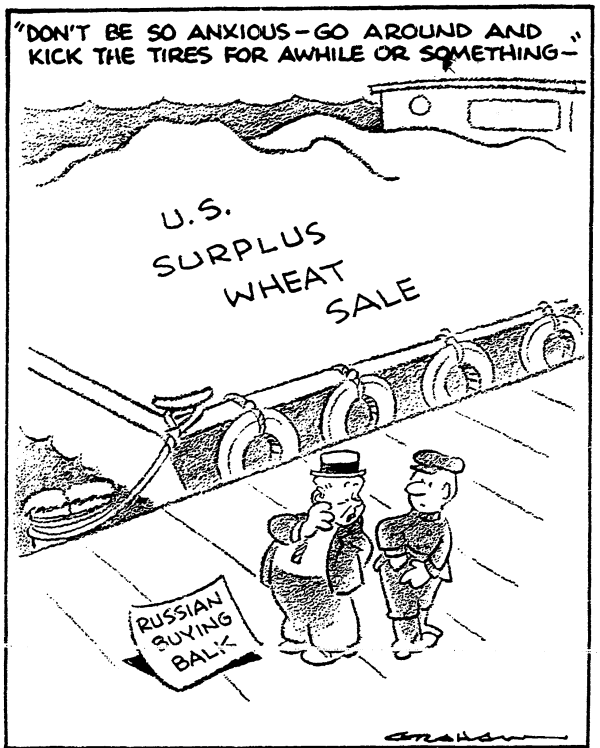
6[?]-: From this cartoon, published in the Arkansas Gazette (Little Rock, Arkansas, USA) of Friday 8th November 1963:
“DON’T BE SO ANXIOUS—GO AROUND AND KICK THE TIRES FOR AWHILE OR SOMETHING—”
7-: From Gemini and Apollo (New York: Duell, Sloan and Pearce, 1964), by the U.S. author Gardner Soule (1913-2000)—pad refers to the launch pad:
Says Virgil I. “Gus” Grissom, the astronaut: “We hope to kick the tires, get in, and go without those long hours on the pad.”
8-: From Con Men: How To Turn Tables on the Wheeler-Dealers, by Sam Weiner, Post business editor, published in The Houston Post (Houston, Texas, USA) of Sunday 26th January 1964—William M. King was a commissioner at the State Securities Board in Austin, Texas:
King believes that the big question that someone should ask himself when he is approached by a stranger offering him a big return on his money is, “Why is he letting me in on it if he wants to keep it a secret?”
If it were really as good a deal as it is presented to be, the wheeler-dealer could get financial backing at a bank, King said.
The investor, King said, should keep in mind that the higher the return on an investment, the higher the risk is.
“You should use the same prudence in investing as you would use in buying anything of value,” he said. “Kick the tires before buying.”
9-: From This Week In Real Estate, by Alice Staples, real-estate editor, published in The Seattle Daily Times (Seattle, Washington, USA) of Friday 20th August 1965:
Settle down to the serious business of finding a home. Consult real-estate offices in the vicinity and find out what is offered and where the houses are in relationship to public facilities.
Look at houses and houses. Study them as carefully as you would if you were buying an automobile. Kick the tires, so to speak.
10-: From the following advertisement, published in the real-estate section of The State Journal-Register (Springfield, Illinois, USA) of Sunday 26th December 1965:
be a skeptic . . .
kick the tires . . . tap on the walls . . . jump on the floor . . . It’s all there to SEE, FEEL or TOUCH, and a better buy in a brick 3 bedrm. 2 bath house can’t be had . . . so don’t pipe-dream away this opportunity. Down payment about $1200
 word histories
I honestly would have thought that the phrase originated much earlier in the 20th century than the 1960s.
LikeLike