The phrase not a cat in hell’s chance means no chance at all—synonyms: a snowball’s chance (in hell) and a Chinaman’s chance. It is a shortening of the more explicit no more chance than a cat in hell without claws. The earliest instance of this phrase that I have found is from Jackson’s Oxford Journal of 29th September 1753: Poor […]
In The Tragedie of Macbeth (around 1603), by the English poet and playwright William Shakespeare (1564-1616), Gray-Malkin is the name of a fiend in the shape of a grey she-cat, the cat being the form most generally assumed by the familiar spirits of witches according to a common superstition: (Folio 1, 1623) […]
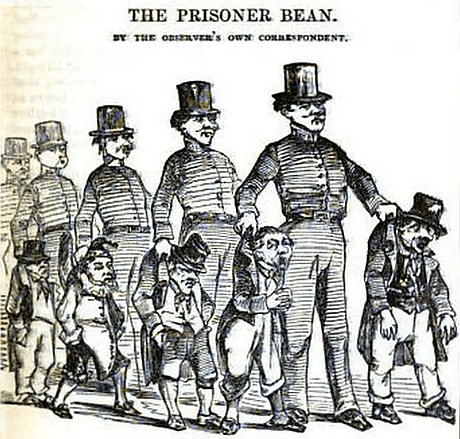
The term human bean is a humorous alteration or mispronunciation of human being, frequently used as part of an extended pun relating to beans. It is first recorded in Punch, or The London Charivari (1842): This little wretch is exciting the most intense interest, (Faugh!) and we have bribed the authorities in all directions to obtain information regarding him. It […]
The verb nail is used to mean to expose or reveal the falsehood of an allegation, assertion, etc., especially to prevent further dissemination. This use is first recorded in An Oration delivered at the Celebration in Philadelphia of the 106th Anniversary of the Birthday of Thomas Paine, by John Alberger, published in The North American […]
The word tennis in its current sense is short for lawn tennis. The original form of tennis (known as real tennis to distinguish it from the later lawn tennis) was played with a solid ball on an enclosed court divided into equal but dissimilar halves, the service side (from which service was always delivered) and […]
The verb to sack (someone) means to dismiss (someone) from employment. This verb seems to have appeared in the first half of the 19th century. For example, the Perthshire Courier (Scotland) of Thursday 29th April 1841 reported that at the Glasgow assizes, during the trial for the murder of a superintendent of Railway labourers, one […]
The phrase from pillar to post means from one place to another in an unceremonious or fruitless manner. Its earliest recorded form is from post to pillar in The Assembly of Gods, an anonymous dream-vision allegory most likely written in the early fourth quarter of the 15th century (it was initially attributed to John Lydgate (1370-1449) […]
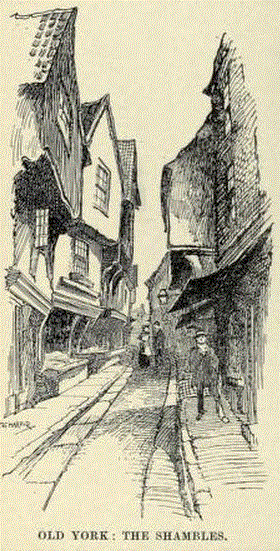
Old York: the Shambles – illustration by Charles G. Harper for his book The Great North Road: The Old Mail Road to Scotland: York to Edinburgh (1901) (The pavements are raised either side of the cobbled street to form a channel where the butchers would wash away the offal and blood.) MEANING […]

 word histories