‘the morning after the night before’: meanings and early occurrences
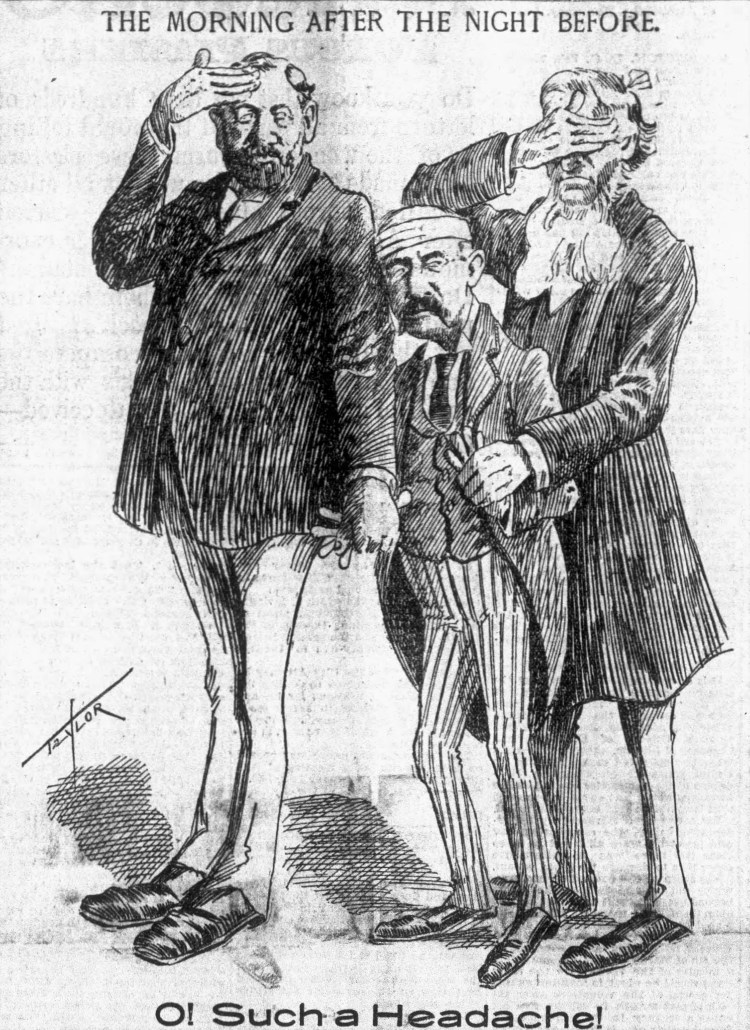
UK, 1860—the morning after an evening of drinking, when one has a hangover—in extended use: the morning after any night of excessive revelry
Read More
“ad fontes!”
UK, 1860—the morning after an evening of drinking, when one has a hangover—in extended use: the morning after any night of excessive revelry
Read Moreto upset, to overturn—1777—origin unknown—perhaps based on Spanish ‘capuzar’, meaning ‘to sink (a ship) by the head’—or perhaps based on a Provençal compound of ‘cap’, meaning ‘head’
Read More1922—‘like death warmed up’ (also ‘like death warmed over’): extended form of ‘like death’, attested in the mid-17th century and meaning ‘extremely ill’, or ‘exhausted’
Read More1922, slang of high-school and university students in Kansas City (Missouri) and in Kansas: a fashionable young man who enjoys socialising with women at tea parties or other social events—1924: a diplomat employed by the U.S. State Department, regarded as being excessively occupied with entertaining dignitaries and doing little meaningful work
Read More1762: the time of night when it is said that witches are active and supernatural occurrences take place—alludes to ‘the witching time of night’ in Shakespeare’s Hamlet—also (1985): the last hour of trading each month when exchange-traded stock options expire
Read More(1836) stormy ocean tracts between latitudes 40° and 50° south—(1867) the fifth decade of life—(1888) the 1840s—(1913) the stretch of Broadway through Times Square, in New York City—(nautical slang) naval commanders aged between 40 and 50 who ‘roar’ commands
Read More
American English—1902: bare feet (used of Doukhobors, i.e., members of a Christian sect that originated in Russia, many members of which emigrated to Canada in the late 19th and early 20th centuries)—1965: open-toed leather sandals of a simple or functional style (used of young persons)
Read MoreUSA, 1922—flappers’ slang: the sum of money that a flapper carried as a precaution so as not to be left financially helpless in case she and her boyfriend got ‘mad’ at each other while on a date
Read MoreUSA, 2003—Following France’s opposition to the proposed U.S.-led invasion of Iraq, the expression ‘freedom fries’ was substituted for ‘French fries’. This, and other expressions in which ‘freedom’ was substituted for ‘French’, may have been coined almost simultaneously by various persons, independently from each other.
Read MoreUSA—of the French: (1954) a workday with a long midday break for a substantial meal and a sleep—of filmmaking in France: (1956) the workday, beginning at noon and without lunch break—of filmmaking in the USA: (2004) a workday without lunch break, during which food is constantly available
Read More word histories