‘blouson noir’: meaning and origin
in French contexts: a young person, especially a young man, belonging to a youth subculture of the 1950s and 1960s—UK, 1959—from the noun ‘blouson’ (a short jacket) and the adjective ‘noir’ (black)
Read More
“ad fontes!”
in French contexts: a young person, especially a young man, belonging to a youth subculture of the 1950s and 1960s—UK, 1959—from the noun ‘blouson’ (a short jacket) and the adjective ‘noir’ (black)
Read Morescarce; infrequent; difficult to find or to come by—one early use in 1668—but popularised by the Irish author Thomas Campbell in The Pleasures of Hope (1799)
Read More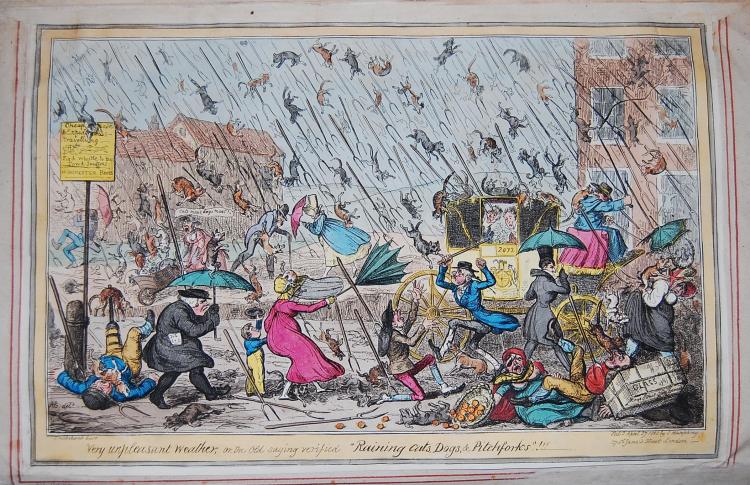
to rain very heavily—UK, 1820—sometimes appended to the phrase ‘to rain cats and dogs’
Read Moreto be glad of minor benefits, especially in an otherwise unpleasant or troublesome situation—first recorded in The Heart of Midlothian (1818), by Walter Scott
Read Morea bias whereby people who have little ability in, or knowledge of, a particular task or subject tend to overestimate their capabilities—USA, 2008—refers to David Dunning and Justin Kruger, who described this bias in the Journal of Personality and Social Psychology in 1999
Read MoreUK, 1856—jocular extension of ‘to rain cats and dogs’ (i.e., ‘to rain very hard’)—puns on the verb ‘hail’ (i.e., ‘to pour down like hail’) and the verb ‘hail’ (i.e., ‘to call out (a cab)’)
Read Morethe action, excitement or trouble starts—USA, late 19th century—originally alluded to the release of a balloon to mark an event
Read Morean event or occasion at which the expected principal participant is not present—coined after ‘Hamlet without the Prince’—‘Lear without the King’ 1904—‘Henry V without the King’ 1964
Read MoreUSA, 1981—said to have been invented by cheerleader ‘Krazy George’—popularised worldwide during the 1986 FIFA World Cup in Mexico, as a translation of Spanish ‘ola’—hence the British phrase ‘Mexican wave’ (1986)
Read Moremeaning: to try especially hard to achieve something or do it well—originally ‘to go the second mile’—alludes to the gospel of Matthew, 5:41: “And whosoeuer shall compell thee to goe a mile, goe with him twaine”
Read More word histories