‘mark twain’: meaning and origin
1809—U.S. nautical, obsolete: the two-fathom mark on a sounding-line—Samuel Langhorne Clemens chose it as his pen-name in 1863, but a pilot named Isaiah Sellers had first used it as his pen-name
Read More
“ad fontes!”
1809—U.S. nautical, obsolete: the two-fathom mark on a sounding-line—Samuel Langhorne Clemens chose it as his pen-name in 1863, but a pilot named Isaiah Sellers had first used it as his pen-name
Read Morealso ‘mustang court’ and ‘kangaroo inquest’—USA, 1840—a mock court that disregards or parodies existing principles of law; any tribunal in which judgment is rendered arbitrarily or unfairly
Read MoreUSA, 1792—to say to a person the things that they want to hear—allegedly from the story of a white man and an Indian who went hunting together, and killed a turkey and a buzzard
Read Moreto vomit from drunkenness—U.S. students’ slang, 1980—likens the position of the hands of a person holding onto the sides of a toilet bowl while vomiting therein, to that of a bus driver’s hands holding the steering wheel
Read Morea person who shows no proficiency in the use of information technology—USA, 1998—from ‘techno-’ in ‘technological’ and ‘technology’, and ‘-saur’ in ‘dinosaur’, i.e., a person who is unable to adapt to change
Read More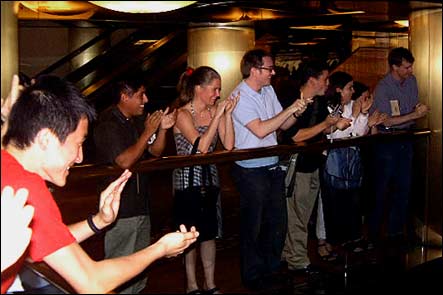
USA, 2003—a group of people organised by means of the internet, mobile phones or other wireless devices, who assemble in public to perform a prearranged action together and then quickly disperse
Read MoreUSA 1813—a heavy metal ball secured by a chain to a person’s leg to prevent escape or as a punishment—figuratively, mid-19th century: anything seen as a heavy restraint, especially the matrimonial bonds
Read More
to put someone in a difficult, vulnerable or compromising situation, especially by exposing them to blame—USA, 1945, sports—the image is of suspending wet washing in the open so that it can dry
Read Morea gesture (made by a French person to deny responsibility, knowledge or agreement) consisting typically in shrugging one’s shoulders while upturning one’s hands
Read Morean impressive facade or show designed to hide an embarrassing or shabby fact or condition—1843—from the sham villages said to have been built by Grigori Potemkin to deceive Catherine II
Read More word histories