Of American-English origin, the phrase to look, or to feel, like something the cat has brought in means to look, or to feel, exhausted or bedraggled. The earliest instances of the form, if not of the phrase, that I have found are in, and as the title of, a story published in The Perrysburg Journal (Perrysburg, Ohio) of 2nd February 1877 […]
The phrase the cup that cheers but not inebriates and its variants refer to tea as a drink which invigorates a person without causing drunkenness. It is from The Winter Evening, the fourth book of The Task. A Poem, in six Books (1785), by the English poet and letter-writer William Cowper (1731-1800): Now stir the fire, and close the […]
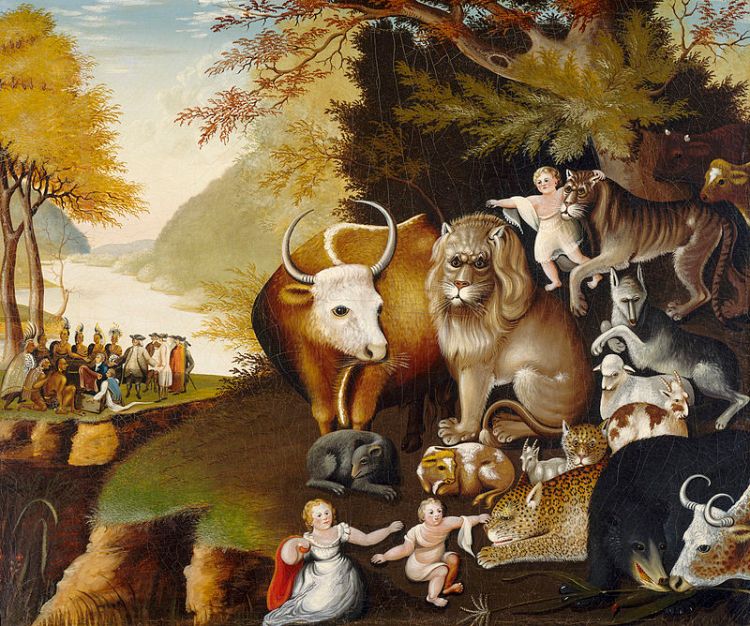
one of the versions of The Peaceable Kingdom (circa 1834), by Edward Hicks image: National Gallery of Art (Washington DC) The expression peaceable kingdom, in the sense of a state of harmony among all creatures as prophesied in the Book of Isaiah, 11:1-9, first appeared in the King James Version (1611): […]
The adjective teetotal in the sense of choosing, or characterised by, total abstinence from all alcohol seems to have first been used about September 1833 by Richard Turner, a worker from Preston, Lancashire, in a speech advocating total abstinence from intoxicating liquors, in preference to abstinence from ardent spirits only (as practised by some early […]
A blend of breakfast and lunch, the noun brunch denotes a late morning meal eaten instead of breakfast and lunch. It originated, apparently in the late 19th century, as Oxford University slang and is first recorded in Lunch at Oxford, by Margaret B. Wright, published in The Independent (New York City, New York, USA) of […]
The phrase like a cat on hot bricks and its American-English equivalent like a cat on a hot tin roof mean very agitated or anxious. An earlier form of the phrase was recorded by the English naturalist and theologian John Ray (1627–1705) in A Collection of English Proverbs (2nd edition – 1678): To go like […]
The adjective fed up means annoyed, unhappy or bored, especially with a situation that has existed for a long time. The original, literal meaning is simply sated with food, since to feed up an animal or a person is to supply them with rich and abundant food. For example, the author of Whether Love be a natural or fictitious Passion, published in Pope’s Bath Chronicle of 3rd May 1764, wrote: The […]
Of American-English origin, the expression to have an axe to grind (American-English spelling ax) means to have a private reason for doing, or being involved in, something. It has often been attributed to Benjamin Franklin [note 1]. For example, the New English Dictionary (NED – 1888), as the Oxford English Dictionary was known, mentions “a […]
The phrase to take French leave means: to depart unnoticed or without permission.—Synonym: to take Dutch leave. The earliest (and most curious) occurrence of to take French leave that I have found is from the anonymous novel Benedicta (1741)—the heroine is about to get married: Mrs Butler, who on this extraordinary occasion, had taken French leave […]
MEANING The phrase (if you’ll) excuse (or pardon) my French is used as an apology for swearing. ORIGIN The current sense seems to derive from an actual apology for speaking French. (It is therefore unnecessary to invoke the centuries-old adversarial relationship between the English and the French.) The form pardon my French is first attested in Randolph, a Novel (1823), by the American […]


 word histories