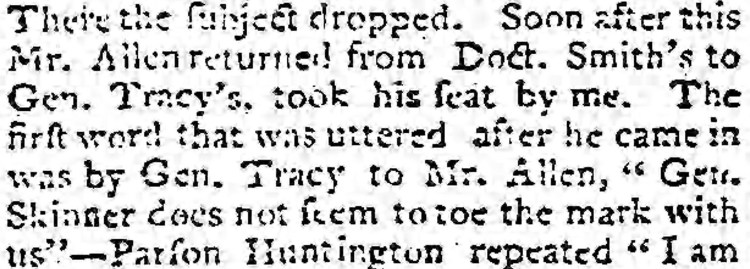
The phrase to toe the line means to accept the authority, policies or principles of a particular group, especially unwillingly. Its literal sense is to stand or crouch with the toes touching the line, especially at the start of a race or fight. The current meaning is an extension of a figurative usage, […]
The phrase not to give, care or be worth a tinker¹’s curse, cuss² or damn (or elliptically a tinker’s) is an intensification of not to give, care or be worth a curse, cuss or damn, with reference to the bad language reputedly used by tinkers. The low repute in which tinkers were held is also […]
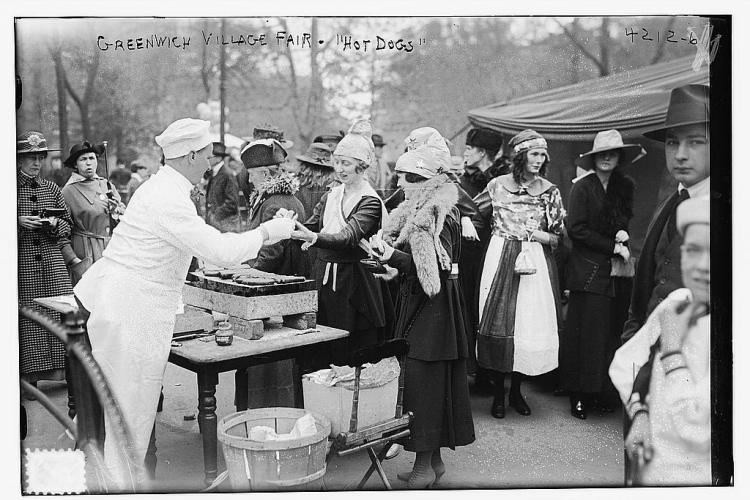
Greenwich Village Fair – “Hot Dogs” – June 1917 photograph: Library of Congress The term hot dog denotes a sausage, especially a frankfurter, served hot in a long roll split lengthways. In US slang, the noun dog has been used to denote a sausage since the late 19th century. This usage is first recorded […]
The term thinking cap denotes an imaginary cap humorously said to be worn in order to facilitate thinking. The earliest instance that I have found is from the Western Carolinian (Salisbury, North Carolina) of 16th October 1821: We advise the editor to put his thinking-cap on, before he hazards another such assertion. The term also […]
A blend of turkey, duck and chicken, the noun turducken designates a poultry dish consisting of a boned chicken inside a boned duck which is in turn placed inside a partially boned turkey, along with seasoned stuffing between the layers of meat and in the central cavity, the whole typically being cooked by roasting. It […]
Eastern Vaudeville Bans Unseemly Slang A general order has been sent out from the Keith office to all Keith, Moss and Proctor vaudeville houses, instructing resident managers to hereafter bar the use by artists of the current slang phrases, “That’s the Cat’s Meow,” “Cat’s Pajamas,” “Hot Dog,” “Hot Cat,” etc. This means the phrases […]
In the USA, cocked hat denoted a game similar to ninepins, except that only three pins were set up, in triangular position. It took its name from cocked hat in the sense of a hat with the brim permanently turned up (i.e. cocked), especially the three-cornered hat of this shape worn at the end […]
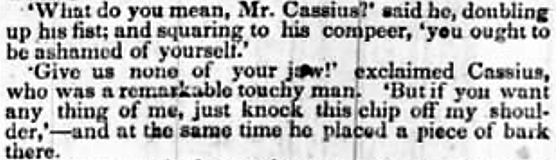
The phrase a chip on one’s shoulder means a challenging or belligerent attitude. In A Concise Dictionary of Phrase and Fable (1993), B. A. Phythian explains: There is an unusual degree of unanimity about the provenance of have a chip on one’s shoulder (bear a grudge; behave anti-socially). Unlikely as it may seem, […]
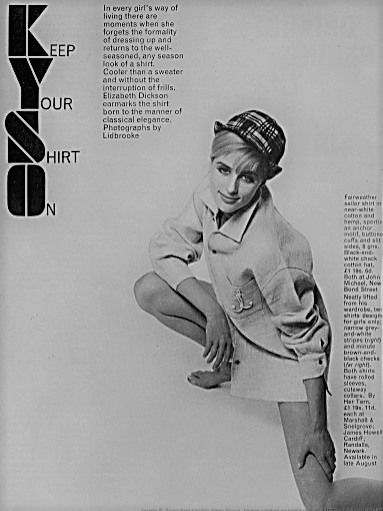
Keep your shirt on In every girl’s way of living there are moments when she forgets the formality of dressing up and returns to the well-seasoned, any season look of a shirt. Cooler than a sweater and without the interruption of frills. Elizabeth Dickson earmarks the shirt born to the manner of classical elegance. advertisement […]
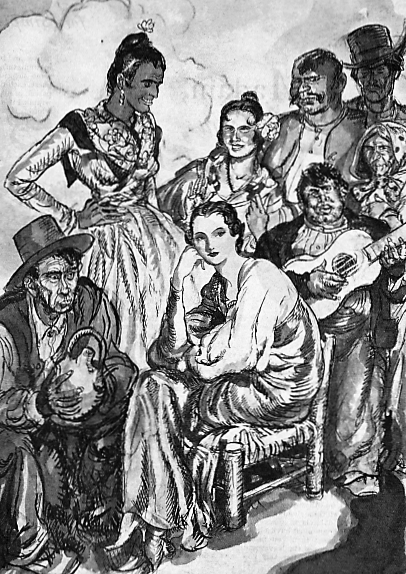
We’ll show her dressed to the nines, posing with a tribe of gypsies in the Pyrenees illustration by Steven Spurrier for The Vanishing Star. A Comedy of Love and Strategy in Hollywood, by Reita Weiman, published in Britannia and Eve (London) of December 1932 The phrase dressed to the nines means dressed […]




 word histories