USA, 1901—Especially in ‘to have them rolling in the aisles’, the colloquial phrase ‘in the aisles’ is used in various expressions to suggest a wildly enthusiastic reaction, especially uncontrollable laughter, on the part of an audience.
from the notion that even a dead cat will bounce if dropped from a sufficient height—UK, 1981: a rapid fall in the stock market with hardly any reaction—USA, 1985: a rapid but short-lived recovery in the stock market after a sharp fall—hence, 1992: any spurious success
‘a stiff upper lip’: a quality of uncomplaining stoicism—now understood as referring to what is believed to be a quintessentially British trait, the repression of emotion, but originated in fact in North America (USA, 1811)
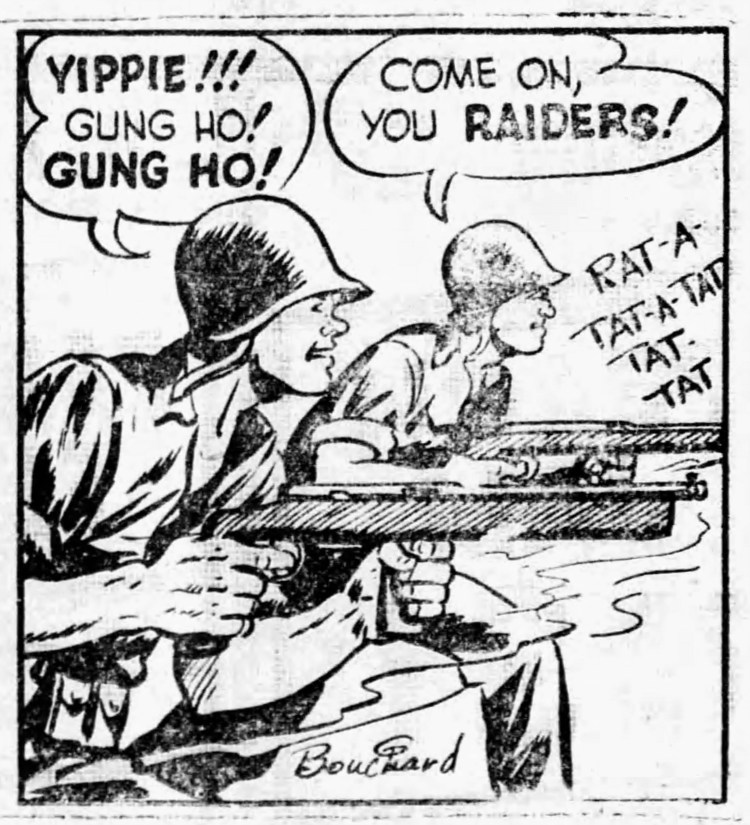
from Chinese ‘gōnghé’, short for ‘Zhōngguó Gōngyè Hézuò Shè’ (Chinese Industrial Cooperative Society)—interpreted as a slogan meaning ‘work together’ (USA, 1941)—adopted by Evans F. Carlson, commander of the 2nd Marine Raider Battalion (1942)
USA, 1916—used in collocation to seek or provide clarification between the two main meanings of ‘funny’: ‘funny-ha-ha’ means ‘funny’ in the sense ‘amusing’ or ‘comical’ – ‘funny-peculiar’ means ‘funny’ in the sense ‘strange’ or ‘peculiar’.
The phrase ‘footloose and fancy-free’ means ‘not committed or tied to anyone or anything’—it appeared in the 1860s only, in U.S. political contexts, although each of its elements dates from the 17th century.
USA, 1917 (with ‘footie’): to touch somebody’s foot lightly with one’s own foot, especially under a table, as a playful expression of romantic interest—hence also, figuratively: to have underhanded dealings with somebody
used to convey that something is unvaryingly familiar or drearily predictable—first recorded (USA, 1963) as the title of a song by Roger Kellaway, American jazz pianist and composer
USA, 1910s—originated in horse racing: ‘under wraps’ is used of a horse that the rider is holding back and intentionally keeping from running at top speed—not from the wrapping placed over newly developed machines before their official launch
USA, 1930—‘to crawl, or to come, out of the woodwork’: of an unpleasant or unwelcome person or thing, to come out of hiding, to emerge from obscurity; the image is of vermin or insects crawling out of crevices or other hidden places in a building

 word histories