‘dad-dancing’: meaning and origin
UK, 1996—an awkward, unfashionable or unrestrained style of dancing to pop music, as characteristically performed by middle-aged or older men
Read More
“ad fontes!”
UK, 1996—an awkward, unfashionable or unrestrained style of dancing to pop music, as characteristically performed by middle-aged or older men
Read MoreUK, 1830—In ‘eligible bachelor’, the adjective ‘eligible’ means ‘suitable as a partner in marriage’.
Read More‘red rag’—a piece of red cloth used to provoke an animal—hence, figuratively, a source of provocation or annoyance, something which excites violent indignation—the notion occurs in the late 16th century
Read More1733—denotes imaginary or non-existent people—refers to John Falstaff’s vaunting tale in the First Part of King Henry the Fourth, by William Shakespeare, in which two men in buckram suits gradually become eleven
Read More‘butterfingered’, adjective, 1615: having a tendency to let things fall or slip from one’s hands—also (English, regional) unable or unwilling to handle hot items with one’s bare hands—‘butterfingers’, noun, 1835: a butterfingered person, a person with a tendency to let things fall or slip from his or her hands
Read MoreUK, 1985—to be ‘stale’, to be no longer innovative, relevant, or effective—refers to the practice introduced in Britain in the early 1970s of stamping perishable goods with the latest date by which they may be sold
Read MoreUK, 1805—personifies France or the French people, or designates a typical Frenchman—composed of ‘Johnny’, a pet form of ‘John’ used, with modifying word, to designate a person of the type, group, etc., specified, and of French ‘crapaud’ (a toad)—coined by British sailors during the Napoleonic Wars
Read More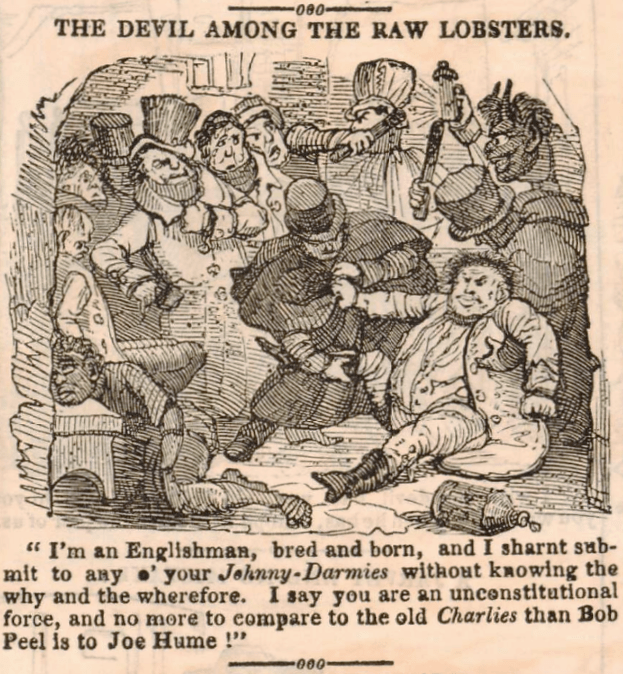
UK, 1830—‘Jenny Darby’, ‘Johnny Darm’, and variants, were originally opprobrious names for any member of the new Metropolitan Police introduced in 1829 by Robert Peel—alterations of ‘gendarme’, with full or partial folk-etymological remodelling variously after the female forename ‘Jenny’, the male forename ‘Johnny’, and the surname ‘Darby’
Read More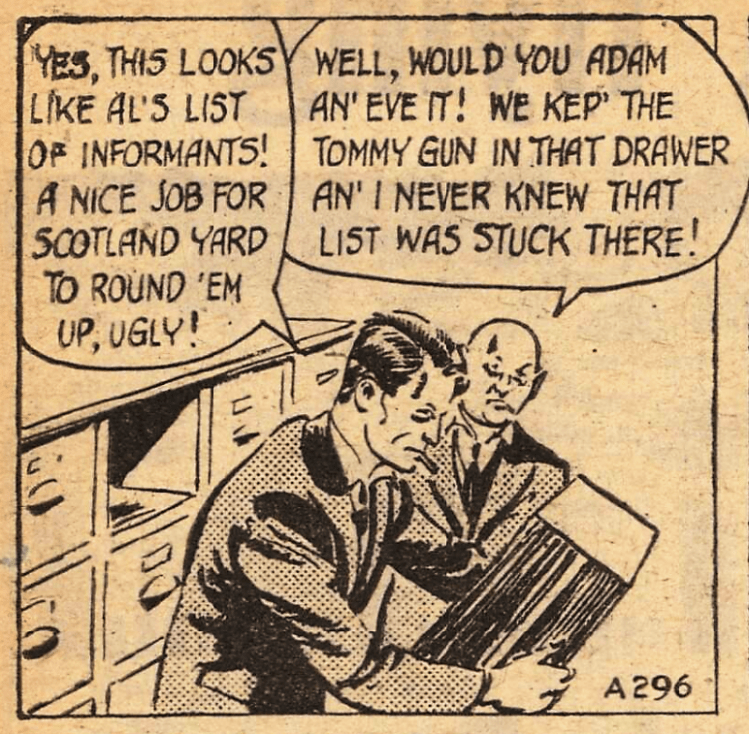
UK, 1925—the verb ‘Adam and Eve’ is rhyming slang for ‘to believe’—there is no truncation, contrary to the usual rhyming-slang formation (cf. ‘scooby’, rhyming slang for ‘clue’, which is short for ‘Scooby Doo’)
Read MoreUK, 1831—used when the result of a contest or the outcome of an action appears certain—originally used of horse racing—the noun ‘shouting’ denotes a loud and enthusiastic show of appreciation
Read More word histories