‘POTUS’ was originally a telegraphic abbreviation.
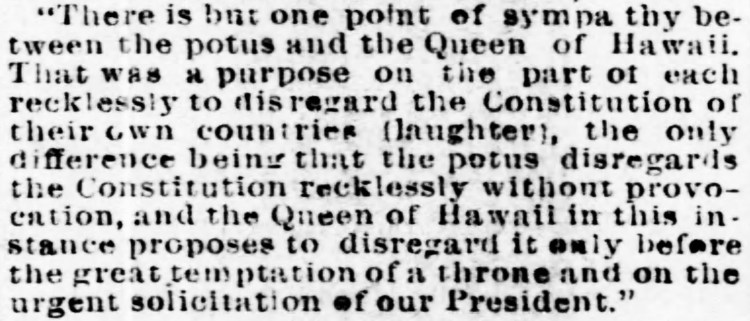
late 19th century—‘POTUS’ was originally an abbreviation used in the Phillips code, a telegraphic code created in 1879 by Walter P. Phillips (1846-1920).
Read More
“ad fontes!”
late 19th century—‘POTUS’ was originally an abbreviation used in the Phillips code, a telegraphic code created in 1879 by Walter P. Phillips (1846-1920).
Read MoreThe pig probably symbolises the unpleasant fact of sweating profusely in the same way as it often represents greed, dirt, etc. in many other derogatory idioms.
Read More
The phrase not to give, care or be worth a tinker¹’s curse, cuss² or damn (or elliptically a tinker’s) is an intensification of not to give, care or be worth a curse, cuss or damn, with reference to the bad language reputedly used by tinkers. The low repute in which tinkers were held is also […]
Read More
Eastern Vaudeville Bans Unseemly Slang A general order has been sent out from the Keith office to all Keith, Moss and Proctor vaudeville houses, instructing resident managers to hereafter bar the use by artists of the current slang phrases, “That’s the Cat’s Meow,” “Cat’s Pajamas,” “Hot Dog,” “Hot Cat,” etc. This means the phrases […]
Read More
Sir John Herschel The announcement last Friday of the death, at the age of 81, of the Rev. Sir John Herschel, Bart., which occurred at Observatory House, Slough, revives a host of memories of 18th century Bath. Sir John Herschel was the great-grandson of Sir William Herschel, the famous astronomer, who discovered from his scientific […]
Read More
used to indicate that someone has finally realised something—UK, 1931—alluded originally to the mechanism of a penny-in-the-slot machine
Read MoreThe word Mayday, which dates from 1923, is used as an international radio distress signal, especially by ships and aircraft. It was supposedly coined by Frederick Stanley Mockford (1897-1962), a senior radio officer at London’s Croydon Airport, but this has not been substantiated: the fact that this story has often been repeated gives it a semblance […]
Read MoreMEANING a heavy cotton pile fabric with lengthways ribs ORIGIN: UNKNOWN The original form of this noun, in the late 18th century, was corderoy. The earliest use of the word that I have found is from The Manchester Mercury (Manchester, Lancashire, England) of Tuesday 7th April 1772: […]
Read More
This word means a toilet, especially an outdoor one. The following is from A Dictionarie of the French and English Tongues (1611), by Randle Cotgrave: Retraict [modern French retrait]: masculine. An Aiax, Priuie, house of Office [= outdoor toilet]. It is a humorous respelling of a jakes, of same meaning, after Ajax, the name […]
Read More word histories