Originally meaning ‘person of ridiculous appearance’, ‘quiz’ (students’ slang, late 18th century) was jocularly derived from the Latin interrogative pronoun ‘quis’ in “Vir bonus est quis?” (“Who is a good man?”)—a good, ingenuous, harmless man being likely to become an object of ridicule or even of harassment.
advertisement for Blotto brothers’ triporteurs Le Jardin des Modes nouvelles – 15th October 1913 The adjective blotto, which means drunk [however, cf. note 1], originated in British military slang during the First World War. It is first recorded in this sense in the chapter Slang in a War Hospital of Observations of an Orderly: […]
It has often been said that the noun banger appeared as British slang for sausage in the World War One trenches (cf. also Zeppelin). But, in fact, it was in use in the British Navy before the outbreak of the war. On 27th July 1904, The Tatler (London) published The real letters of […]
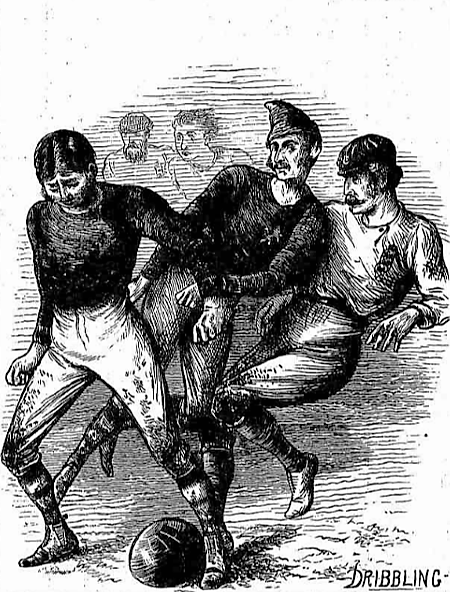
This important match was played on Saturday, November 30, on the ground of the West of Scotland Cricket Club, at Partick, near Glasgow, and was the first international match played in Scotland according to the Association rules. Four matches had been previously played in London between London Scotchmen and Englishmen. (The illustration, from Sketches […]
Politicians usually work with blue smoke and mirrors. What appears to be real is mostly an illusion, and what is unlikely turns out to be real. But sometimes, the blue smoke and mirrors don’t work. When you can’t produce a budget, you can’t call a news conference and pretend you did. from The News […]
The informal British phrase to chance one’s arm means to undertake something although it may be dangerous or unsuccessful. Its origin is unclear. The earliest use that I have found is from How our blue-jackets are fed, an article about the “diet of the British sailor at sea” published in The Weekly Telegraph […]
The phrase not to give, care or be worth a tinker¹’s curse, cuss² or damn (or elliptically a tinker’s) is an intensification of not to give, care or be worth a curse, cuss or damn, with reference to the bad language reputedly used by tinkers. The low repute in which tinkers were held is also […]
Eastern Vaudeville Bans Unseemly Slang A general order has been sent out from the Keith office to all Keith, Moss and Proctor vaudeville houses, instructing resident managers to hereafter bar the use by artists of the current slang phrases, “That’s the Cat’s Meow,” “Cat’s Pajamas,” “Hot Dog,” “Hot Cat,” etc. This means the phrases […]
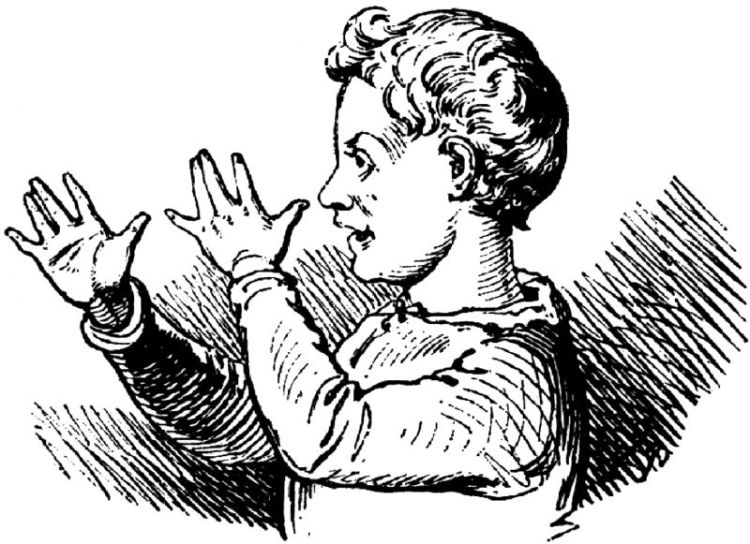
The phrase to cock (also to cut, to pull) a snook, or snooks, means: – literally: to make a gesture of derision by putting one’s thumb to one’s nose and outspreading the fingers; this gesture can be intensified by joining the tip of the little finger to the thumb of the other hand, whose fingers are […]
In the USA, cocked hat denoted a game similar to ninepins, except that only three pins were set up, in triangular position. It took its name from cocked hat in the sense of a hat with the brim permanently turned up (i.e. cocked), especially the three-cornered hat of this shape worn at the end […]





 word histories