‘to know —— like the back of one’s hand’ – ‘connaître —— comme sa poche’
first attested in David Balfour (1893), by Robert Louis Stevenson—French equivalent ‘connaître comme sa/ses poche(s)’ (‘to know like one’s pocket(s)’ – 1791)
Read More
“ad fontes!”
first attested in David Balfour (1893), by Robert Louis Stevenson—French equivalent ‘connaître comme sa/ses poche(s)’ (‘to know like one’s pocket(s)’ – 1791)
Read MoreScotland, 1749—from the idea of daring to grab a lion’s “beard” and figurative uses of ‘beard’: (verb) ‘confront’ – (noun) ‘face’
Read Morevery fast, or very hard—UK, 1942, RAF slang—alludes to the moving metal piece within a bell, which strikes it and produces the sound
Read More
Scotland, 1914: ‘buroo’, informal form of ‘bureau’ (generic sense)—later used specifically in the sense of Labour Bureau, hence of unemployment benefit (1921)
Read Moreultimately based on the fable of the mice, or rats, who proposed to hang a bell round the cat’s neck, so as to be warned of its approach
Read More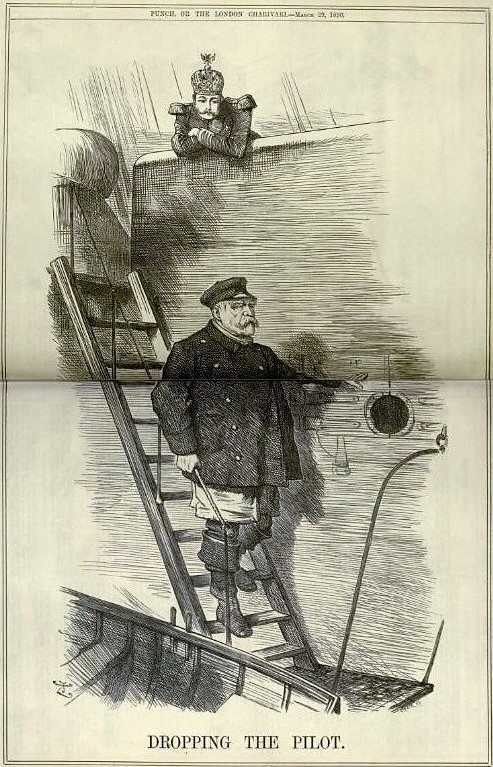
John Tenniel popularised the phrase in a cartoon depicting the dismissal of Otto von Bismarck, published in Punch (London) of 29 March 1890.
Read Moremeaning: everything is or will turn out all right—Scotland, 1891—‘bob’ probably related to the adjectives ‘bob’ and ‘bobbish’, meaning ‘well, in good health and spirits’
Read More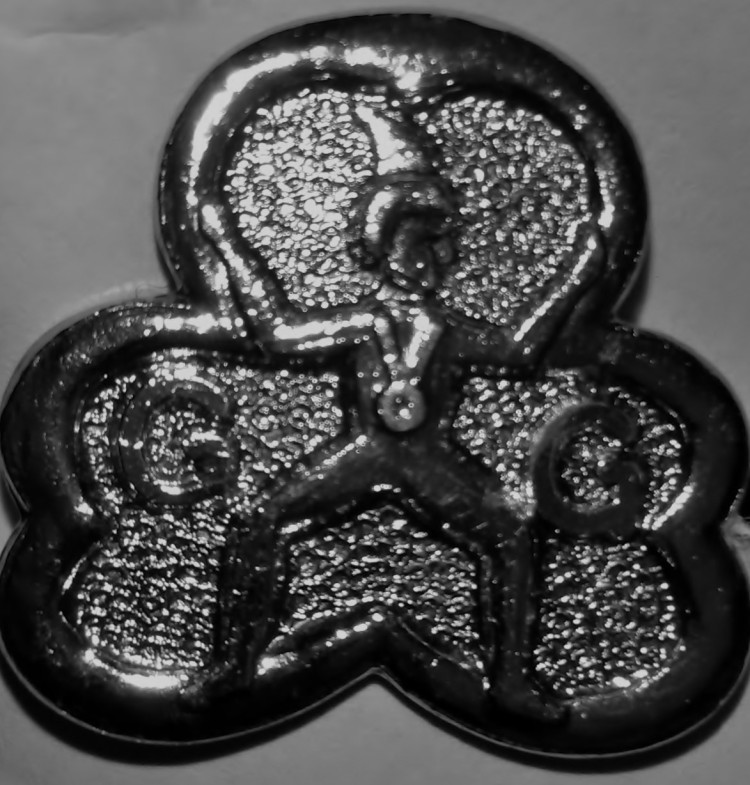
1916—from ‘brownie’, i.e. a benevolent elf that supposedly haunts houses and does housework secretly—not from the fact that the uniform of the junior Girl Scouts and Girl Guides is brown
Read MoreThe phrase ‘a far cry’ means ‘something very different’. Its literal signification (first recorded in A Legend of Montrose (1819), by Walter Scott) is ‘a long way’, ‘a great distance’. Here, the noun ‘cry’ denotes ‘a calling distance’, as in ‘within cry of’, meaning ‘within calling distance of’.
Read MoreUSA, 1811—based on the three principal components that make up a flintlock gun: ‘lock’ denotes the firing mechanism, ‘stock’ the handle or wooden shoulder-piece to which it is attached, and ‘barrel’ the tube down which the bullet is fired
Read More word histories