The name ‘Quorn’ was first registered as a trademark—for certain edible products other than meat substitutes—by the Quorn Specialities Company of Leicester, England, in 1914. The meat substitute was subsequently developed by the successors of this company.
The literal meaning of ‘rocket science’ (USA, 1930) is the science of rockets and rocket propulsion—in the 1980s, in connexion with sports, it came to be used ironically as a generic term for anything requiring a high level of intelligence or expertise.
‘Atlantic’ originally referred to Mount Atlas in North Africa, on which the heavens were fabled to rest; it was hence applied to the sea near the western shore of Africa, and afterwards extended to the whole ocean lying between Europe and Africa on the east and America on the west.
from army use on the Western Front during World War One: ‘cootie’, ‘body louse’, ‘cooty’, ‘infested with lice’, ‘coot’, ‘louse’, probably ultimately refer to the aquatic bird called ‘coot’, reputed to be lice-infested
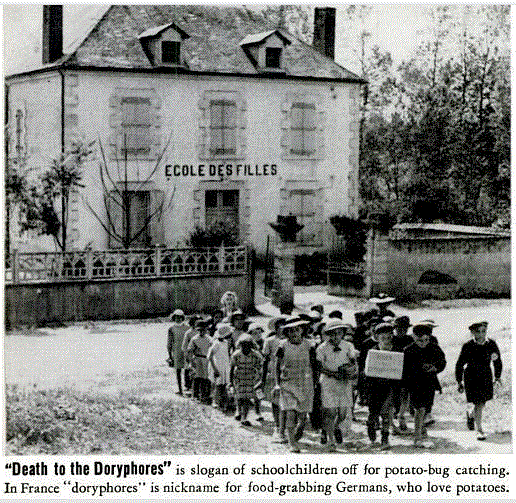
Greek ‘δορυϕόρος’ (‘doruphόros’) meant ‘spearman’; in French, ‘doryphore’ denotes the Colorado beetle and the German occupying forces during WWII; in English, it denotes a pedantic and annoyingly persistent critic.
Greek ‘skíouros’, ultimate origin of ‘squirrel’: folk-etymologically interpreted as meaning ‘shadow-tailed’ because when the animal sits erect, it raises its tail up against its back and over its head as if to shade itself
early 21st century—acronym from ‘Completely Automatic Public Turing test to tell Computers and Humans Apart’, with punning allusion to ‘capture’ and ‘gotcha’
The word ‘folklore’ was coined in 1846 by the British author William John Thoms, inspired by Jacob and Wilhelm Grimm’s anthology of German fairy tales.



 word histories