a woman’s topless swimsuit, consisting of the lower half of a bikini—from the prefix ‘mono-’ and ‘-kini’ in ‘bikini’, reinterpreted as containing the prefix ‘bi-’—coined in 1946 by French clothing designer Louis Réard
a film which fails to achieve the commercial success that was expected—UK, 1986—from ‘flop’ (a failure) and ‘-buster’ in ‘blockbuster’ (a film which achieves great commercial success)
a person who shows no proficiency in the use of information technology—USA, 1998—from ‘techno-’ in ‘technological’ and ‘technology’, and ‘-saur’ in ‘dinosaur’, i.e., a person who is unable to adapt to change
the Jerusalem artichoke—UK, 1968—blend of ‘fart’ and ‘artichoke’ in ‘Jerusalem artichoke’—refers to the flatulence caused by eating Jerusalem artichokes
UK, 1954—the economic policy of Rab Butler, Conservative Chancellor of the Exchequer (1951-5), regarded as largely indistinguishable from that of Hugh Gaitskell, Labour Chancellor of the Exchequer (1950-1)—blend of ‘Butler’ and ‘Gaitskell’ plus suffix ‘-ism’
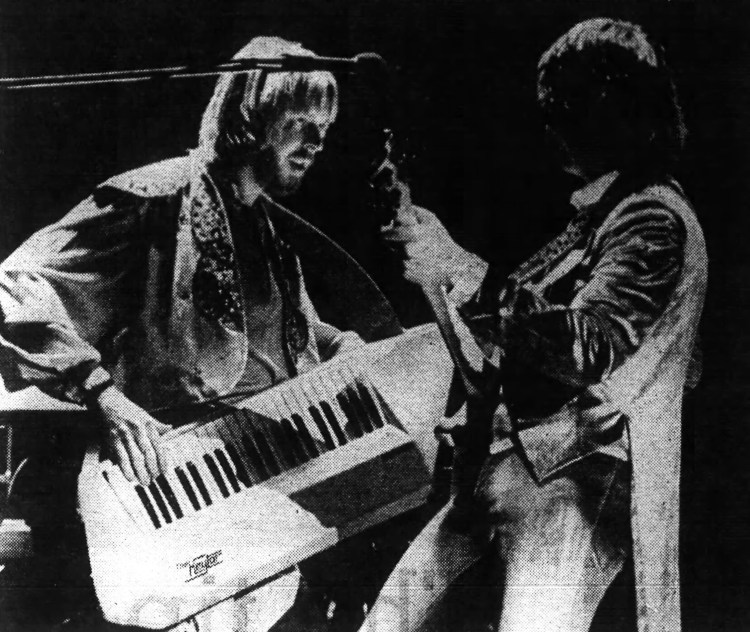
a synthesizer designed to be held in the manner of a guitar, with one hand playing a keyboard while the other operates controls on an extended handle—USA, 1979—from ‘key-’ in ‘keyboard’ and ‘-tar’ in ‘guitar’
USA, 2019, derogatory—people (regarded as elitist and pretentious) who are alert to racial or social discrimination and injustice—a blend of the adjective ‘woke’ and of the noun ‘literati’
denotes a film, television programme, etc., which adopts the form of a serious documentary in order to satirise its subject—apparently first used (and perhaps coined) in 1952 by the Canadian television producer Ross McLean
a television programme or cinema film exhibiting qualities of both drama and comedy—USA, 1998—blend of ‘soap (opera)’, or of ‘soaper’, and of ‘comedy’—coined on various occasions by different persons, independently from one another
a country characterised by absurdity—originally used of Czechoslovakia—the suffix ‘-istan’ (in country names such as ‘Pakistan’) is used as the second element in satirical names denoting, in particular, ‘a country characterised by [the first element]’