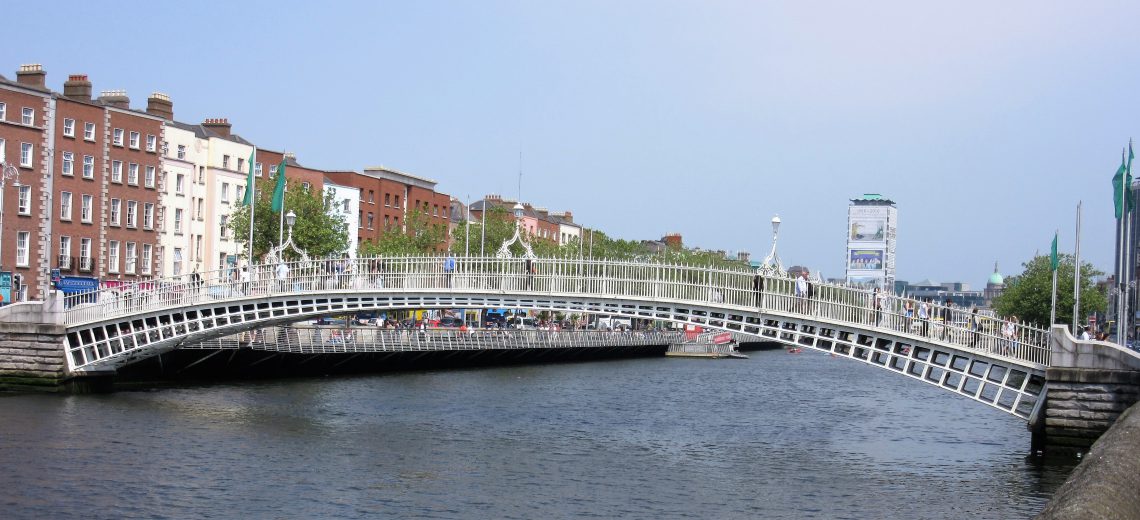
The phrase ‘a pretty kettle of fish’ originally referred to a net full of fish, which, when drawn up with its contents, is suggestive of confusion, flurry and disorder—‘kettle’ being a form of ‘kiddle’, a noun denoting a dam or other barrier in a river, with an opening fitted with nets to catch fish.
“Go by Shanks’ pony – Walk short distances and leave room for those who have longer journeys” – a Second World War poster by Lewitt-Him for the Ministry of War Transport – image: Imperial War Museums The phrase Shanks’(s) pony, or mare, etc, means one’s own legs as a means of conveyance. It is […]
MEANING The phrase to beggar belief (or description) means to be too extraordinary to be believed (or described). ORIGIN The literal meaning of the verb to beggar is to make a beggar of, exhaust the means of, reduce to beggary. It came to be used figuratively to mean to exhaust the resources […]
The phrase to carry coals to Newcastle means to supply something to a place where it is already plentiful; hence, figuratively, to do something wholly superfluous or unnecessary—cf. also to sell refrigerators to the Eskimos and to sell sand in the Sahara. This phrase (in which coals is an obsolete plural) refers to Newcastle upon Tyne, in […]
It was only from the mere accident of his bearing the name that he did that the phrase ‘Hobson’s choice’ was applied to Thomas Hobson (1544-1631), an English liveryman who supposedly gave his customers no choice but to take the horse closest to the stable door or none at all. MEANING The […]
MEANING The phrase donkey’s years means a very long time. ORIGIN This expression is inseparable from donkey’s ears. In fact, these two expressions were originally a single one, donkey’s years being simply a dialectal pronunciation of donkey’s ears—or the other way around. And donkey’s ears/years (also donkeys’ ears/years) was part of a […]
Buggins’ turn, or Buggins’s turn, is the principle of assigning an appointment to persons in rotation rather than according to merit. The earliest recorded use of this expression is in a letter written on 13th January 1901 by the British admiral Lord John Arbuthnot Fisher (1841-1920): Favouritism was the secret of our efficiency in the […]
MEANING to smell a rat: to detect something suspicious ORIGIN The first known use of this phrase is in The Image of Ipocrysy, an anonymous poem written around 1540, denouncing “the cruell clergy”: (published in 1843) Suche be owr [= our] primates, Our bisshopps and prelates, Our parsons and curates, With other […]
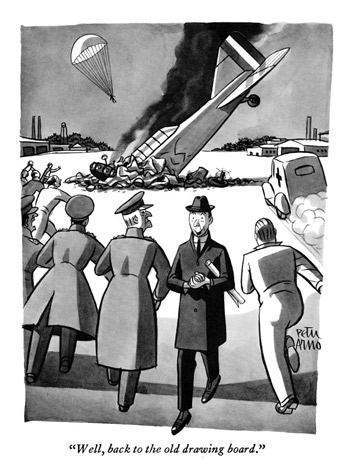
MEANING The phrase back to the drawing board is used to indicate that an idea, scheme or proposal has been unsuccessful and that a new one must be devised. ORIGIN This phrase originated in a cartoon by the U.S. cartoonist Peter Arno (Curtis Arnoux Peters, Jr – 1904-68), published in The New […]
The phrase to sleep like a top means to sleep very soundly. In A Concise Dictionary of Phrase and Fable (1993), B. A. Phythian explains that, unlikely as it may seem, the top referred to here is the child’s toy which seems not to be moving when it is spinning, though it wobbles when being […]