MEANING a single fortunate event doesn’t mean that what follows will also be good ORIGIN The annual migration of swallows to Europe from southern climes at the end of winter was the subject of a proverb in Ancient Greece: μία χελιδὼν ἔαρ οὐ ποιεῖ, in which ἔαρ means spring; it is found […]
The phrase ‘pour encourager les autres’ (‘in order to encourage the others’) was coined by Voltaire with reference to the execution of Admiral John Byng in 1757.
Figuratively, a loose cannon is an unpredictable or uncontrolled person who is liable to cause unintentional damage. But in practice, it was one inadequately lashed in place on the deck of a ship, which caused havoc by rolling dangerously and unpredictably. The first known mention of a loose cannon being tossed about the deck of […]
MEANINGS – attractive articles of little value or use – practices or beliefs that are superficially or visually appealing but have little real value or worth ORIGIN The noun trumpery, first recorded in the mid-15th century, is from the French noun tromperie, which means deception, trickery. This was one of the original meanings in […]
The phrase to teach one’s grandmother to suck eggs means to presume to advise a more experienced person. Raw eggs, with or without a little seasoning, used to be a popular food and were regarded as healthy. Grandmothers obviously needed no instruction about how to drink them. The phrase is first recorded in a translation from Spanish by […]
MEANING the depths of one’s conscience or emotions ORIGIN This anatomically curious but firmly established expression is a variant of the older and more comprehensible heart of heart, meaning very centre of the heart, which was coined by the English poet and playwright William Shakespeare (1564-1616) in The Tragicall Historie of Hamlet, […]
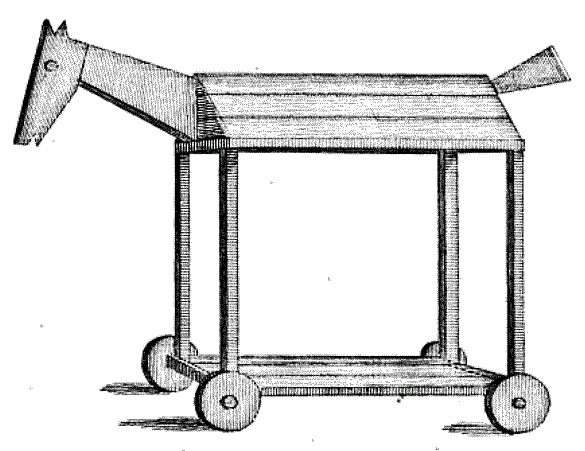
The phrase a horse that was foaled of an acorn denoted the gibbet, sometimes also called triple tree. In A Collection of English Proverbs (1678), the English naturalist and theologian John Ray (1627-1705) wrote: You’ll ride on a horse that was foal’d of an acorn. That is the gallows. Pelham; or, The Adventures […]
MEANING of payments: without delay ORIGIN This expression refers to the fingernail and might originally have alluded to drinking fair and square. A clue might be provided by the French phrase payer rubis sur l’ongle (literally to pay ruby on the fingernail), which means to pay exactly what is due. (A variant, used by prostitutes, was rubis sur pieu, […]
The expression short shrift means brief and unsympathetic treatment, and to make short shrift of means to dispose of quickly and unsympathetically. A short shrift was originally a brief space of time allowed for a criminal to make his or her confession before execution. The expression is first recorded in The Tragedy of King Richard […]
Witham is the name of several villages in Lincolnshire and Essex. With a pun on wit, the expression little, or small, Witham was used proverbially for a place of which the inhabitants were remarkable for stupidity. For example, the following, from A fourth hundred of epygrams (1560) by the English playwright and epigrammatist John Heywood […]