The noun marrowsky, which has also been spelt Marouski, Marowsky, morowski and mowrowsky, denotes a variety of slang, or a slip in speaking, characterised by the transposition of the initial letters or syllables of two words. The more usual term is spoonerism (cf. also malapropism and eggcorn). The word is first recorded in the verbal form Marrowskying in […]
photograph of William Archibald Spooner in The Leeds Mercury (Yorkshire) of Monday 1st September 1930 There is a rather awkward moment in “An Italian Straw Hat” when Laurence Payne, as a young bridegroom, looking desperately into the auditorium of the Old Vic, cries: “The thick plottens!” Hearing this elementary Spoonerism, graver members of the […]
The word cheese is from Old English cēse, cȳse, of West-Germanic origin; it is related to its Dutch and German equivalents kaas and Käse respectively. Those words are ultimately derived from Latin caseus, cheese, which is also the origin of: – Spanish queso – Portuguese queijo – regional Italian cacio – Romanian: caș. Based on […]
image: nageur-sauveteur MEANINGS The noun starboard denotes the side of a ship or aircraft that is on the right when one is facing forward, while port denotes the opposing side. ORIGINS From the Germanic bases of the nouns steer and board, starboard, which appeared in Old English as steorbord, denotes literally the steer board, the steer side. This side of the ship […]
The obsolete adjective hail meant free from injury, infirmity or disease. It is from Old Norse heill, meaning whole, hale, sound. This Old Norse word is related to the English adjectives whole and hale, which are doublets, as they are both from Old English hāl. The current spelling of whole, which first appeared in the […]
The term Richard Snary is an alteration, with humorous substitution of Richard for the pet-form Dick, of Dick Snary, itself a humorous remodelling of dictionary. These terms are first recorded in Apollo shrouing composed for the schollars of the free-schoole of Hadleigh in Suffolke. And acted by them on Shrouetuesday, being the sixt of February, 1626, by William Hawkins (died 1637): – I […]
The word pedigree appeared in the early 15th century in the Latin form pedicru and in English forms such as pe-de-grew and pedegru, from Anglo-Norman French pé de grue and variants (pied de grue in Modern French), meaning literally foot of crane. The Anglo-Norman French word is first recorded during the second Michaelmas term (i.e. during the second session, beginning soon after Michaelmas, of the […]
MAIN MEANINGS – verb: to behave as though sexually attracted to someone, but playfully rather than with serious intentions – noun: a person who acts flirtatiously ORIGIN The verb flirt is probably onomatopoeic, the phonetic elements /fl-/ and /-əːt/ both suggesting sudden movement. It may therefore be comparable to verbs such as […]
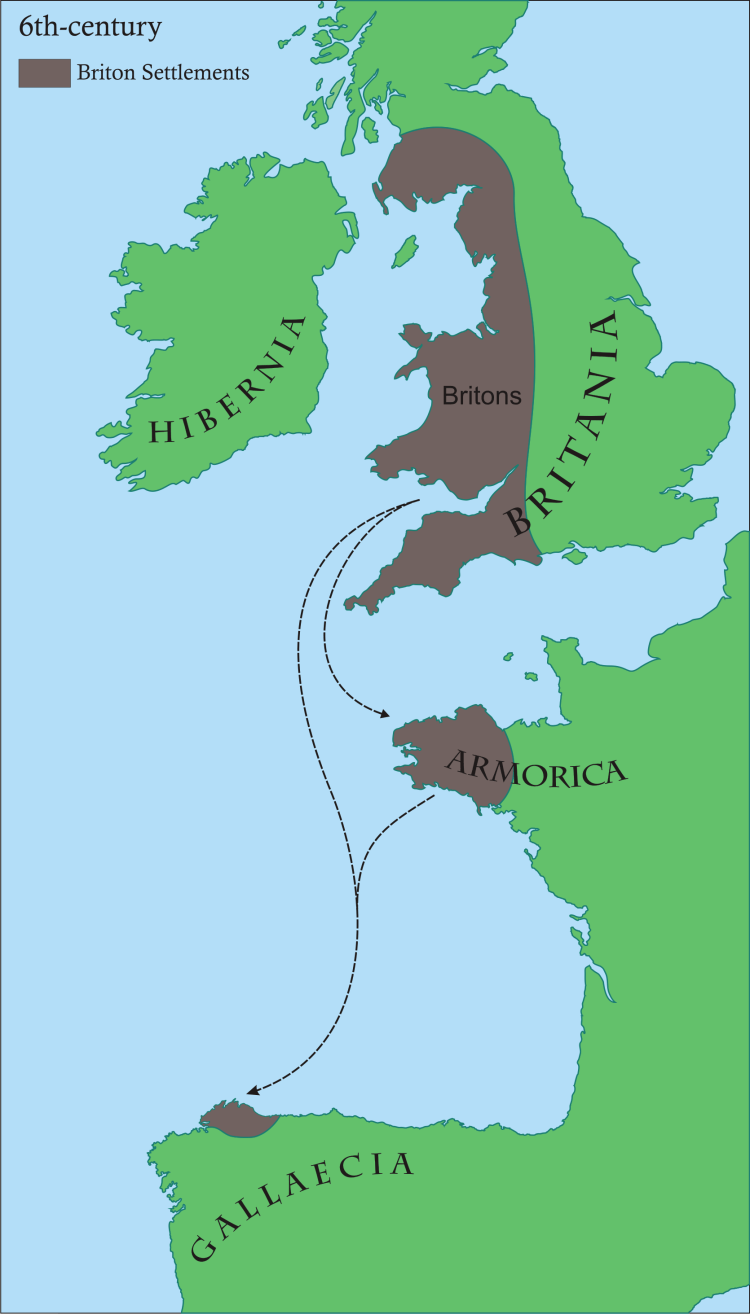
Briton settlements in the 6th century – settlements of the Angles, Saxons and Jutes in Britain, circa 600 In the following, Briton will refer to the Celtic Brittonic-speaking peoples who inhabited Britain south of the Firth of Forth, and who, following the arrival of the Anglo-Saxons in the 5th century, gradually retreated until the […]
The English poet John Taylor (1578-1653) wrote, in The great eater, of Kent, or Part of the admirable teeth and stomacks exploits of Nicholas Wood, of Harrisom in the county of Kent His excessiue manner of eating without manners, in strange and true manner described, by Iohn Taylor (1630): One Iohn Dale was too hard […]



 word histories