photograph: Farm Shop The noun mayonnaise denotes a thick, creamy sauce consisting of egg yolks emulsified with oil and seasoned, used as a cold dressing or accompaniment for salad, eggs, fish, etc., or as the base for other sauces. It is used in two French phrases: la mayonnaise prend, literally, the mayonnaise […]
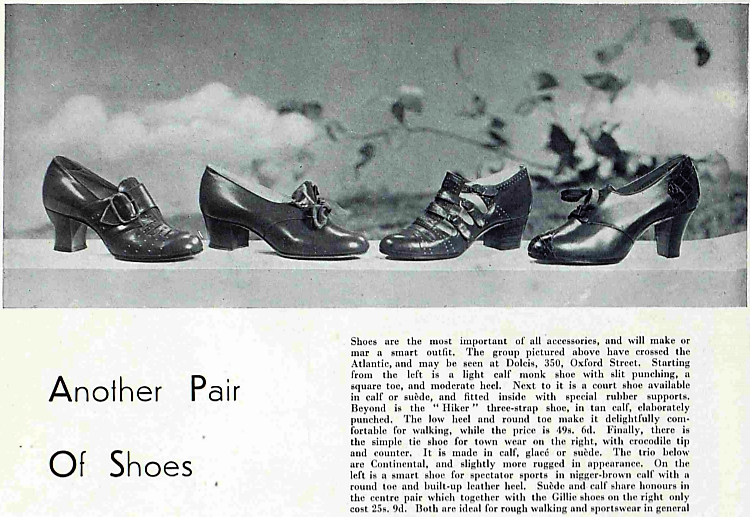
Another Pair Of Shoes Shoes are the most important of all accessories, and will make or mar a smart outfit. The group pictured above have crossed the Atlantic, and may be seen at Dolcis, 350, Oxford Street. Starting from the left is a light calf monk shoe with slit punching, a square toe, and […]
The noun marrowsky, which has also been spelt Marouski, Marowsky, morowski and mowrowsky, denotes a variety of slang, or a slip in speaking, characterised by the transposition of the initial letters or syllables of two words. The more usual term is spoonerism (cf. also malapropism and eggcorn). The word is first recorded in the verbal form Marrowskying in […]
The word cheese is from Old English cēse, cȳse, of West-Germanic origin; it is related to its Dutch and German equivalents kaas and Käse respectively. Those words are ultimately derived from Latin caseus, cheese, which is also the origin of: – Spanish queso – Portuguese queijo – regional Italian cacio – Romanian: caș. Based on […]
The primary meaning of the humorous pseudo-French British-English expression nul points is: a score of zero points in the Eurovision Song Contest, in which the points awarded by each country are announced in both English and French. This expression is composed of: – the French adjective nul, meaning no (that is, not one); the choice of […]
The Italian noun gianduia (improperly gianduja) appeared in the 19th century to denote a soft confection made with chocolate and ground hazelnuts, first produced in Turin, the capital of Piedmont, a region in north-western Italy, in the foothills of the Alps. (The Italian name is Piemonte, from piede, foot, and monte, mount.) This confection was […]
image: nageur-sauveteur MEANINGS The noun starboard denotes the side of a ship or aircraft that is on the right when one is facing forward, while port denotes the opposing side. ORIGINS From the Germanic bases of the nouns steer and board, starboard, which appeared in Old English as steorbord, denotes literally the steer board, the steer side. This side of the ship […]
Unexpectedly, the words fawn, meaning a young deer in its first year, and fetus (or foetus), meaning an unborn or unhatched offspring of a mammal, are doublets: they go back to the same etymological source but differ in form and meaning. While fetus has remained identical to this source, the form fawn is the result of sound changes—cf. also turban – tulip, clock – cloak, […]
The obsolete adjective hail meant free from injury, infirmity or disease. It is from Old Norse heill, meaning whole, hale, sound. This Old Norse word is related to the English adjectives whole and hale, which are doublets, as they are both from Old English hāl. The current spelling of whole, which first appeared in the […]
The noun window is from Middle English windoȝe, a borrowing from Old Norse vindauga, literally wind’s eye, from vindr, wind, and auga, eye. The Scandinavian word replaced and finally superseded Old English éagþyrel, i.e. eyethirl, composed of the nouns eye and thirl. The noun thirl denoted a hole, an aperture, and was derived from Old English þurh, thorough. It was long used in some dialects of English; for instance, […]



 word histories