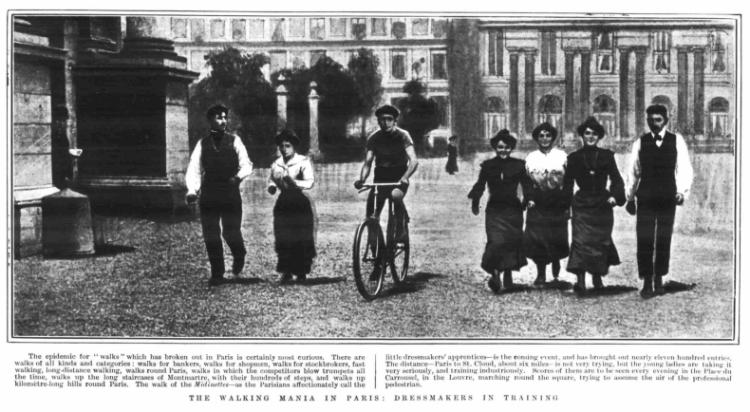
Phonetically and semantically similar to milliner, the French word midinette was defined as “a milliner’s female assistant, especially in Paris” in the 1933 Supplement to the New English Dictionary (as the Oxford English Dictionary was known). However, while milliner literally means a Milanese, a native or inhabitant of Milan, midinette is a portmanteau word, composed […]
A milliner is a person (generally a woman) who makes or sells women’s hats. But a Milliner was originally a native or inhabitant of Milan, a city in northern Italy. The word is first recorded in this sense in an Act of Parliament in 1449: That every Venician, Italian, Januey, Florentyn, Milener, Lucan, Cateloner, Albertyns, […]
MEANING the fourth estate: the press; the profession of journalism ORIGIN The first known user of the expression, designating the ordinary people, was the English author and magistrate Henry Fielding (1707-54) writing, under the pseudonym of Sir Alexander Drawcansir, Knt. Censor of Great Britain, in The Covent-Garden Journal of Saturday 13th June […]
The phrase at (or in) one fell swoop means all in one go. Here, the noun swoop, which denotes the act of swooping down, refers to the sudden pouncing of a bird of prey (a kite for example) from a height upon its quarry (of Germanic origin, the verb swoop is cognate with sweep). The […]
The word tennis in its current sense is short for lawn tennis. The original form of tennis (known as real tennis to distinguish it from the later lawn tennis) was played with a solid ball on an enclosed court divided into equal but dissimilar halves, the service side (from which service was always delivered) and […]
The verb to sack (someone) means to dismiss (someone) from employment. This verb seems to have appeared in the first half of the 19th century. For example, the Perthshire Courier (Scotland) of Thursday 29th April 1841 reported that at the Glasgow assizes, during the trial for the murder of a superintendent of Railway labourers, one […]
The phrase from pillar to post means from one place to another in an unceremonious or fruitless manner. Its earliest recorded form is from post to pillar in The Assembly of Gods, an anonymous dream-vision allegory most likely written in the early fourth quarter of the 15th century (it was initially attributed to John Lydgate (1370-1449) […]
The noun ‘gongoozler’, denoting a person who stares protractedly at anything, originally designated an idler who stares at length at activity on a canal.
MEANING The phrase to beggar belief (or description) means to be too extraordinary to be believed (or described). ORIGIN The literal meaning of the verb to beggar is to make a beggar of, exhaust the means of, reduce to beggary. It came to be used figuratively to mean to exhaust the resources […]
MEANING a young man paid or financially supported by a woman, typically an older woman, to be her escort or lover ORIGIN In English, gigolo originally denoted a professional male dancing-partner. One of its first users was the American novelist, short story writer and playwright Edna Ferber (1885-1968) in Gigolo, which was published in […]