The white cliffs of Dover— to which the name Albion did not originally refer [cf. note]. (photograph: Wikimedia Commons/Fanny) The name Albion first appeared in English in the very first sentence of the first Book of the 9th-century translation of Historia ecclesiastica gentis anglorum (The Ecclesiastical History of the English People) originally written by the English monk, […]
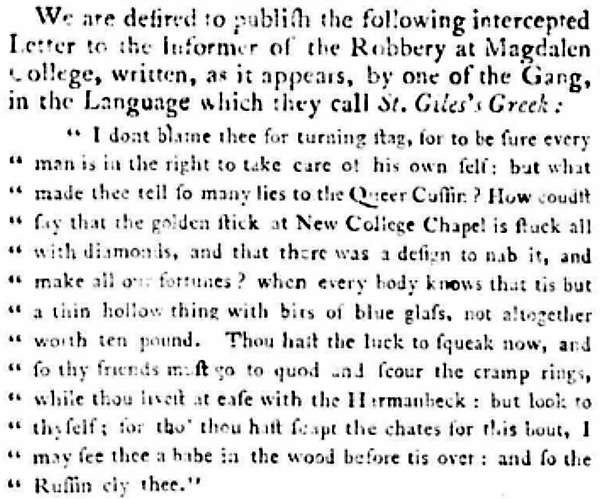
The noun Greek has long been used in the sense of unintelligible speech or language, gibberish, and the phrase it’s (all) Greek to me means I can’t understand it at all. This expression is well known from The Tragedie of Julius Cæsar (1599), by the English playwright and poet William Shakespeare (1564-1616): (Folio […]
The word cheese is from Old English cēse, cȳse, of West-Germanic origin; it is related to its Dutch and German equivalents kaas and Käse respectively. Those words are ultimately derived from Latin caseus, cheese, which is also the origin of: – Spanish queso – Portuguese queijo – regional Italian cacio – Romanian: caș. Based on […]
photograph: Google+ Communities The noun philtrum denotes the vertical groove between the base of the nose and the border of the upper lip. The literal and obsolete signification of this word, which appeared in the early 17th century, is love potion, from classical Latin philtrum, of same meaning. In post-classical Latin, philtrum came to also denote the dimple in the upper lip. It […]
In this expression, the noun poke denotes a bag, a small sack. It is from Anglo-Norman and Old Northern French forms such as poke and pouque, variants of the Old French forms poche and pouche — the last of which is the origin of English pouch. (Incidentally, English pocket is from Anglo-Norman poket, pokete, diminutive forms of poke.) The expression to buy a pig in a poke simply cautions against buying or accepting […]
It is often said that the abbreviated form Xmas “takes the Christ out of Christmas”, but this is not the case. For example, a certain Reverend Thomas Eyre wrote to a Doctor Poynter on 25th January 1807: My Lord,—Your much esteemed favour of the 5th of December I received the day after Xmas. The noun Christ is from the Latin Christus, […]
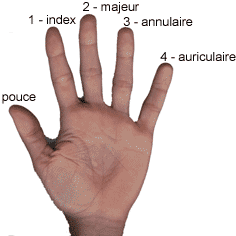
In the Etymologies (Etymologiarum sive Originum libri viginti), compiled between around 615 and the early 630s in the form of an encyclopaedia arranged by subject matter, St Isidore (circa 560–636), bishop of Seville and Doctor of the Church, wrote the following about the names of the fingers (the original Latin words are […]
The French masculine noun sanglier denotes a full-grown wild boar. It literally means a boar living on its own, separated from the herd, since, via Old and Middle French forms such as sengler and senglier, it is from the popular Latin singularis (porcus), solitary (pig) – cf. Middle-French terms such as porc sanglier, and in the Vulgate, the Latin version of the Bible, singularis ferus, the noun ferus meaning wild animal (cf. the […]
In The Tragedie of Macbeth (around 1603), by the English poet and playwright William Shakespeare (1564-1616), Gray-Malkin is the name of a fiend in the shape of a grey she-cat, the cat being the form most generally assumed by the familiar spirits of witches according to a common superstition: (Folio 1, 1623) […]
In the chapter Our lunatic contributor of Words and names (1933), the British philologist Ernest Weekley (1865-1954) wrote: The correspondence columns of our middlebrow weeklies and of our two Sunday papers are the happy hunting-ground of the amateur etymologist. A few years ago he published the discovery that ‘nap,’ ‘a short sleep,’ was derived from Napoleon’s power of sleeping […]



 word histories