meaning and origin of the phrase ‘to have a bee in one’s bonnet’
This phrase is a transformation of ‘one’s head full of bees’, meaning scatter-brained, unable to think straight, as if bees are buzzing around in one’s head.
Read More
“ad fontes!”
This phrase is a transformation of ‘one’s head full of bees’, meaning scatter-brained, unable to think straight, as if bees are buzzing around in one’s head.
Read More
‘(As) mad as a March hare’ refers to the fact that, in the breeding season, the hare is characterised by much leaping, boxing and chasing in circles.
Read More
It is a circumstance rather remarkable, that the answer to Sir George Rodney’s summons of surrender, given by the respective Dutch Governours of the Islands of St. Eustatius and St. Martin’s, should be couched exactly in the same form of words without the smallest variation; from this we are either to suppose, that the […]
Read More
The Excommunication of Robert the Pious (1875), by the French artist Jean-Paul Laurens (1838-1921)—image: Wikimedia Commons The officiants have just excommunicated Robert by bell, book, and candle [note 1], and left the quenched candle behind. Robert II (972-1031), known as the Pious, the son of Hugues Capet, was excommunicated for incest by Pope Gregory V […]
Read More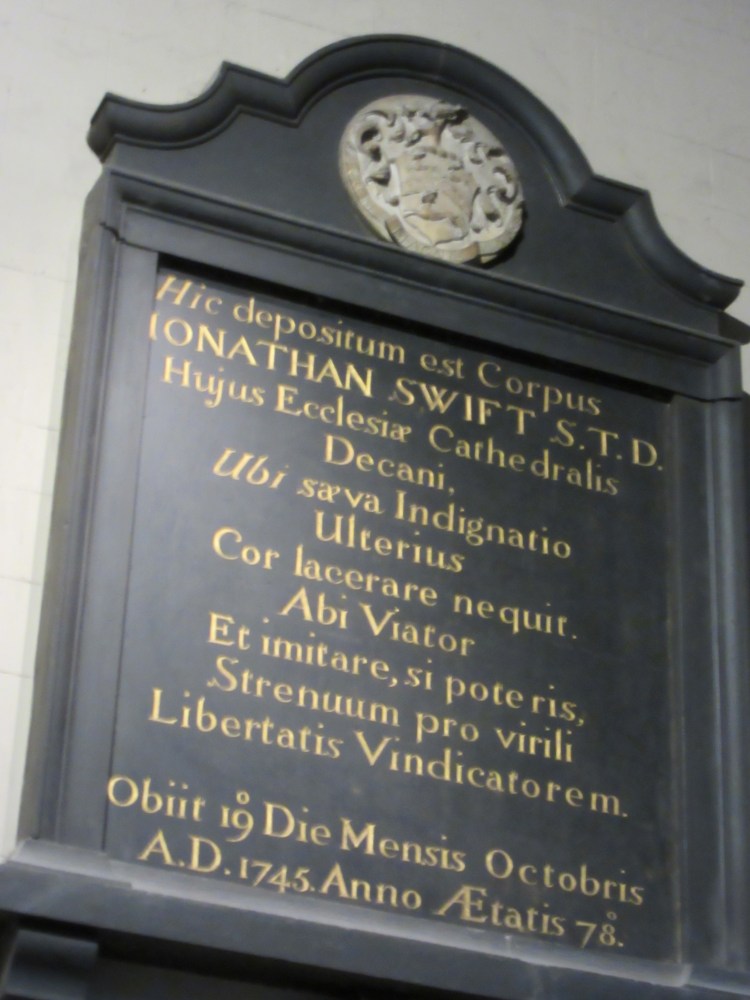
Jonathan Swift’s grave, marked by a simple brass plaque on the floor at the west end of St Patrick’s Cathedral, Dublin, is adjacent to that of his great friend in life, Stella (Esther Johnson – 1681-1728): plaques marking the graves of Jonathan Swift and Esther Johnson Latin sæva indignatio, meaning savage indignation, expresses a […]
Read MoreThe word kidney, which is attested around 1325, is of unclear origin. The second element of the Middle-English form kidenei, plural kideneiren, is apparently ey, plural eyren, meaning egg (cf. German Eier, literally eggs, used to mean testicles). The first element remains uncertain; it is perhaps identical with cud. The Anglo-Saxon name for kidney was […]
Read MoreThe phrase to teach one’s grandmother to suck eggs means to presume to advise a more experienced person. Raw eggs, with or without a little seasoning, used to be a popular food and were regarded as healthy. Grandmothers obviously needed no instruction about how to drink them. The phrase is first recorded in a translation from Spanish by […]
Read MoreAmong other figurative meanings, the adjective thick has the sense of close in confidence and association, intimate, familiar. In Literary Anecdotes of the Eighteenth Century, published in 1812, John Nichols quoted Edmund Law (1703-87), Bishop of Carlisle: “Yes,” said he, “we begin now, though contrary to my expectation, and without my seeking, to be pretty thick; and I thank God, who reconciles me to […]
Read MoreMEANING The following definition of budget is from the New English Dictionary (i.e. Oxford English Dictionary – 1888 edition): A statement of the probable revenue and expenditure for the ensuing year, with financial proposals founded thereon, annually submitted by the Chancellor of the Exchequer, on behalf of the Ministry, for the approval of the House […]
Read MoreThe English poet John Taylor (1578-1653) wrote, in The great eater, of Kent, or Part of the admirable teeth and stomacks exploits of Nicholas Wood, of Harrisom in the county of Kent His excessiue manner of eating without manners, in strange and true manner described, by Iohn Taylor (1630): One Iohn Dale was too hard […]
Read More word histories