MEANINGS – attractive articles of little value or use – practices or beliefs that are superficially or visually appealing but have little real value or worth ORIGIN The noun trumpery, first recorded in the mid-15th century, is from the French noun tromperie, which means deception, trickery. This was one of the original meanings in […]
The phrase to teach one’s grandmother to suck eggs means to presume to advise a more experienced person. Raw eggs, with or without a little seasoning, used to be a popular food and were regarded as healthy. Grandmothers obviously needed no instruction about how to drink them. The phrase is first recorded in a translation from Spanish by […]
The obsolete adjective hail meant free from injury, infirmity or disease. It is from Old Norse heill, meaning whole, hale, sound. This Old Norse word is related to the English adjectives whole and hale, which are doublets, as they are both from Old English hāl. The current spelling of whole, which first appeared in the […]
The noun pastis designates an aniseed-flavoured aperitif, while pastiche, or pasticcio, denotes a work of art that imitates the style of another artist or period and a work of art that mixes styles, materials, etc. Unlikely as it may seem, these words are doublets, or etymological twins: although they differ in form and meaning, they go […]
The phrase caviar to the general is used to denote a good thing unappreciated by the ignorant (here, the general refers to the multitude). It is from The Tragicall Historie of Hamlet, Prince of Denmarke (between 1599 and 1602), by the English poet and playwright William Shakespeare (1564-1616): (Quarto 2, 1604) – Hamlet: Come giue vs a tast of your quality, come […]
A milliner is a person (generally a woman) who makes or sells women’s hats. But a Milliner was originally a native or inhabitant of Milan, a city in northern Italy. The word is first recorded in this sense in an Act of Parliament in 1449: That every Venician, Italian, Januey, Florentyn, Milener, Lucan, Cateloner, Albertyns, […]
MEANING a man unduly concerned with looking stylish and fashionable ORIGIN As it was originally in use on the Scottish Border at the end of the 18th century, dandy represents perhaps the name Andrew. (From Dandie Dinmont (i.e. Andrew Dinmont), the name of a character in Guy Mannering; or, The Astrologer (1815), […]
The word tennis in its current sense is short for lawn tennis. The original form of tennis (known as real tennis to distinguish it from the later lawn tennis) was played with a solid ball on an enclosed court divided into equal but dissimilar halves, the service side (from which service was always delivered) and […]
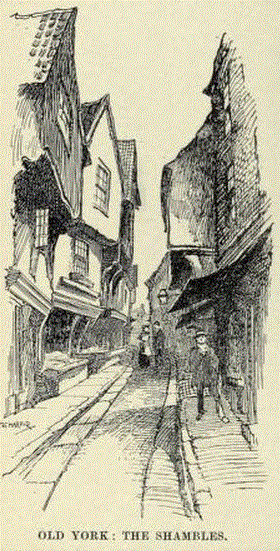
Old York: the Shambles – illustration by Charles G. Harper for his book The Great North Road: The Old Mail Road to Scotland: York to Edinburgh (1901) (The pavements are raised either side of the cobbled street to form a channel where the butchers would wash away the offal and blood.) MEANING […]

 word histories