the gods at the Comedy Theatre, London, 1949 source: Historic England – The Theatres Trust Via Middle French galerie, the noun gallery, attested in the late 15th century, is from the medieval Latin of Italy galeria, an alteration of medieval Latin galilaea, designating a porch at the entrance of a monastery’s church—hence English […]
Of American-English origin, Simon says denotes a children’s game in which players must obey the leader’s instructions only if they are prefaced with the words Simon says; it also denotes the command itself. The name Simon was probably chosen for alliterative effect (Simon says). —Synonymous phrase: O’Grady says. The earliest instance of the phrase Simon […]
There are two Valentines, both Italian, one a priest and the other a bishop, who were martyred and used to be commemorated in the Roman Catholic calendar on 14th February. However, they have no romantic associations and the modern customs linked with St Valentine’s Day arise from a tradition according to which it is the day when the […]
detail from the frontispiece to The Life of an Actor (1825), by Pierce Egan The phrase to get, or to give, the bird means to receive, or to show, derision, to be dismissed, or to dismiss. It originated in theatrical slang and referred to the ‘big bird’, that is, the goose, which hisses as people do when they make a sound of disapproval […]
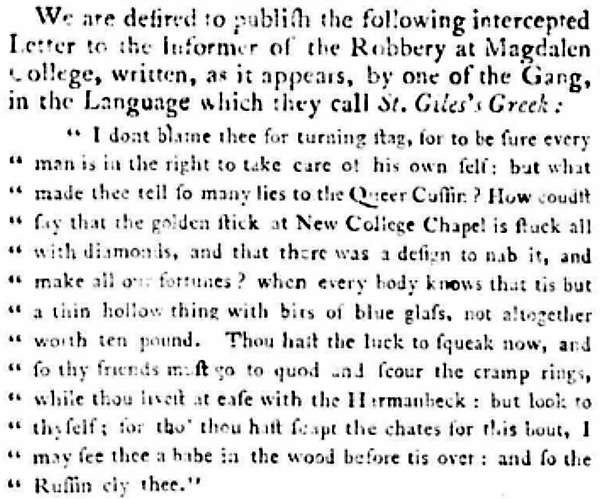
The noun Greek has long been used in the sense of unintelligible speech or language, gibberish, and the phrase it’s (all) Greek to me means I can’t understand it at all. This expression is well known from The Tragedie of Julius Cæsar (1599), by the English playwright and poet William Shakespeare (1564-1616): (Folio […]
Executioner argues with King about cutting off Cheshire Cat’s head – illustration by John Tenniel (1820-1914) for Alice’s Adventures in Wonderland (1865) The executioner’s argument was, that you couldn’t cut off a head unless there was a body to cut it off from. The phrase a cat may look at a king means even a person of low […]
The Italian noun gianduia (improperly gianduja) appeared in the 19th century to denote a soft confection made with chocolate and ground hazelnuts, first produced in Turin, the capital of Piedmont, a region in north-western Italy, in the foothills of the Alps. (The Italian name is Piemonte, from piede, foot, and monte, mount.) This confection was […]
MEANING to pay excessively, to be charged exorbitantly PROBABLE ORIGIN The expression to pay through the nose is first recorded in Piazza universale di proverbi Italiani, or, A common place of Italian proverbs and proverbial phrases digested in alphabetical order (1666), by Giovanni Torriano (floruit 1640): Oft-times Rich men engrossing commodities, will make one pay through the […]
MEANING The phrase (if you’ll) excuse (or pardon) my French is used as an apology for swearing. ORIGIN The current sense seems to derive from an actual apology for speaking French. (It is therefore unnecessary to invoke the centuries-old adversarial relationship between the English and the French.) The form pardon my French is first attested in Randolph, a Novel (1823), by the American […]
In A Dictionarie of the French and English Tongues (1611), Randle Cotgrave gave the following definition of the French word gazette: A certaine Venetian coyne scarce worth our farthing; also, a Bill of Newes; or, a short Relation of the generall occurrences of the Time, forged most commonly at Venice, and thence dispersed, euery month, into most parts of Christendome. […]




 word histories