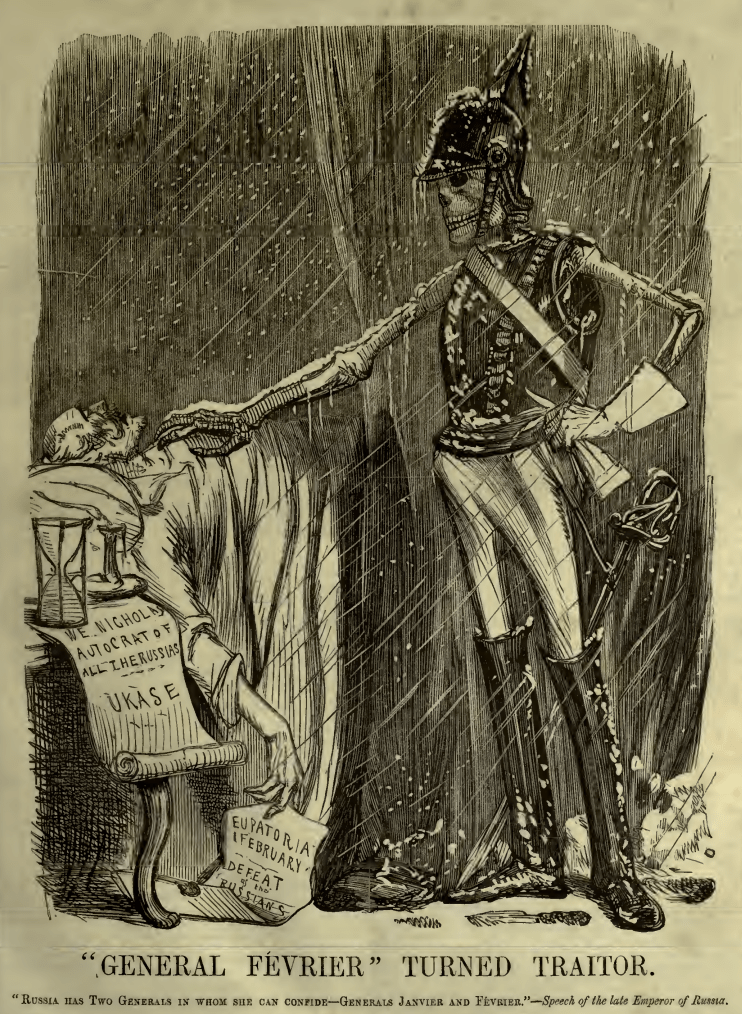
personify January and February as army commanders, especially in reference to winter as detrimental or destructive to a military campaign—apparently coined by Russian Prince Alexander Menshikov in 1855, during the Crimean War
suicide committed by a person, especially a child or young adult, as a result of being bullied—blend of the nouns ‘bully’ and ‘suicide’—coined since 2001 on separate occasions by various persons, independently from one another
The noun ‘dunny’ denotes a toilet, especially an outside toilet. This noun has been used in various phrases expressing notions such as conspicuousness, loneliness, ill luck, etc.
UK, 1866—used as an observation, a reproof or a warning implying over-cleverness—plays on two meanings of the adjective ‘sharp’: a) literal meaning: ‘cutting’; b) figurative meaning: ‘keen-witted’
diarrhoea suffered by travellers, especially in Egypt—USA, 1973—does not seem to have been coined after the synonymous ‘Montezuma’s Revenge’—may somehow allude to the legendary curse of the pharaohs
to vomit, especially from drunkenness—slang, obsolete—1609 as ‘to jerk the cat’—perhaps alludes to the fact that cats are prone to vomit—cf. also the obsolete French verb ‘renarder’, to vomit, from the noun ‘renard’, denoting a fox
UK, 1972—the nouns ‘granny-bashing’ and ‘granny-battering’ denote: a) the assault or mugging of elderly persons; b) abuse of an elderly member of one’s family, especially one’s grandmother
left-handed: ‘molly-handed’, ‘mauldy’, ‘molly-dooked’—a left-handed person: ‘molly-hander’, ‘mauldy’, ‘molly-dook’—‘molly’ and ‘mauldy’ may derive from ‘mauley’, denoting the hand or fist; ‘dook’ is ‘duke’, denoting the hand or fist


 word histories