1950—the exercise of ploys and tactics in order to minimise time spent waiting in a queue—composed of the noun ‘queue’ and the suffix ‘-manship’—here, ‘-manship’ does not refer to the skills worthy of a role, as in ‘horsemanship’ and ‘statesmanship’, but to the ploys used to gain the upper hand, as in ‘gamesmanship’
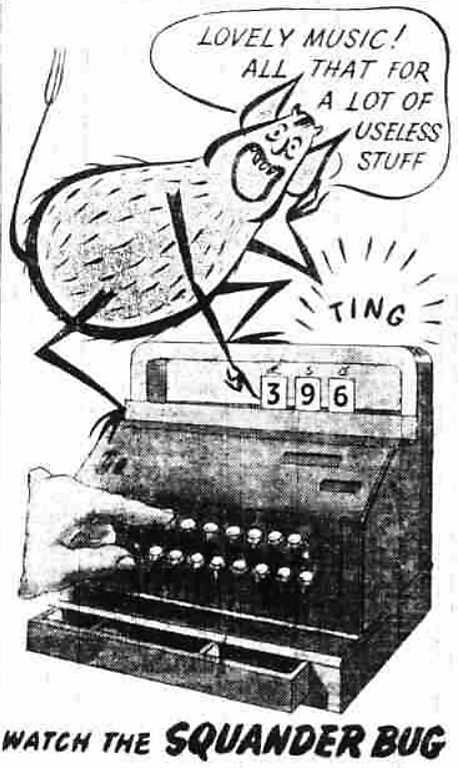
1943—a devilish insect symbolising reckless extravagance and waste—introduced by the National Savings Committee in a government publicity campaign promoting economy—hence: one who is profligate with money or resources
1907—whether one likes it or not; haphazardly—a humorous variant of ‘willy-nilly’, after the personal name ‘William’ (‘William’ being familiarly shortened to ‘Willy’)
USA, 1927—denotes male vigour, especially sexual—with wordplay on ‘penis’—interestingly, via an alteration of the Latin diminutive ‘pēnĭcillus’, denoting literally a little tail, hence a painter’s brush or pencil, ‘pencil’ is derived from Latin ‘pēnis’, denoting literally a tail, hence the penis
to use unnecessary force in destroying something fragile—alludes to a wheel used as an instrument of torture—first occurs in An Epistle from Mr. Pope, to Dr. Arbuthnot (1734), by the English poet Alexander Pope (1688-1744), who perhaps coined this phrase
1945—a woman from Liverpool, a city and seaport in north-western England—from the noun ‘Scouser’, denoting a person from Liverpool, and the suffix ‘-ette’, used to form nouns denoting female gender
UK, 1933—a jump made with a parachute—hence also the verbal noun ‘brolly-hopping’ and the verb ‘brolly-hop’—‘brolly’ (university slang, late 19th century): a clipped and altered form of ‘umbrella’
1947—the unauthorised dumping of waste, especially while in the process of transporting it—‘fly’ refers to ‘on the fly’, meaning ‘while in motion or progress’—‘tipping’ is the gerund of the verb ‘tip’, in the sense ‘to dump’
UK, 1972—the offence of taking a car without the owner’s consent, especially for the purpose of joyriding, which was a social phenomenon prevalent in north-eastern England—acronym for ‘taking without owner’s consent’

 word histories