The proper name Guy is derived, via French, from the Old German Wido, either from wit, meaning wide, or from witu, wood. Wido has become Guy in French because in words of Germanic origin, when initial, the labio-velar approximant /w/ has regularly become the velar /g/. For instance, in the French noun loup-garou, the element garou corresponds to English werewolf—in fact, loup was added when the […]
MEANINGS – attractive articles of little value or use – practices or beliefs that are superficially or visually appealing but have little real value or worth ORIGIN The noun trumpery, first recorded in the mid-15th century, is from the French noun tromperie, which means deception, trickery. This was one of the original meanings in […]
The expression short shrift means brief and unsympathetic treatment, and to make short shrift of means to dispose of quickly and unsympathetically. A short shrift was originally a brief space of time allowed for a criminal to make his or her confession before execution. The expression is first recorded in The Tragedy of King Richard […]
Witham is the name of several villages in Lincolnshire and Essex. With a pun on wit, the expression little, or small, Witham was used proverbially for a place of which the inhabitants were remarkable for stupidity. For example, the following, from A fourth hundred of epygrams (1560) by the English playwright and epigrammatist John Heywood […]
The obsolete adjective hail meant free from injury, infirmity or disease. It is from Old Norse heill, meaning whole, hale, sound. This Old Norse word is related to the English adjectives whole and hale, which are doublets, as they are both from Old English hāl. The current spelling of whole, which first appeared in the […]
According to the post-biblical Christian tradition, the apple is the fruit of the tree of knowledge of good and evil eaten by Adam and Eve in the Garden of Eden in defiance of God’s commandment. However, in the Book of Genesis, the type of fruit eaten by Adam and Eve is not specified. In the King James Version (1611), the two […]
The noun window is from Middle English windoȝe, a borrowing from Old Norse vindauga, literally wind’s eye, from vindr, wind, and auga, eye. The Scandinavian word replaced and finally superseded Old English éagþyrel, i.e. eyethirl, composed of the nouns eye and thirl. The noun thirl denoted a hole, an aperture, and was derived from Old English þurh, thorough. It was long used in some dialects of English; for instance, […]
MEANING a persistent or desperate hope that is unlikely to be fulfilled, a faint hope, a ‘hope against hope’ ORIGIN On the face of it, this is a curious expression, because the adjective forlorn does not normally mean faint but miserable, lonely, forsaken or sad. The current sense of forlorn hope derives […]
The phrase at (or in) one fell swoop means all in one go. Here, the noun swoop, which denotes the act of swooping down, refers to the sudden pouncing of a bird of prey (a kite for example) from a height upon its quarry (of Germanic origin, the verb swoop is cognate with sweep). The […]
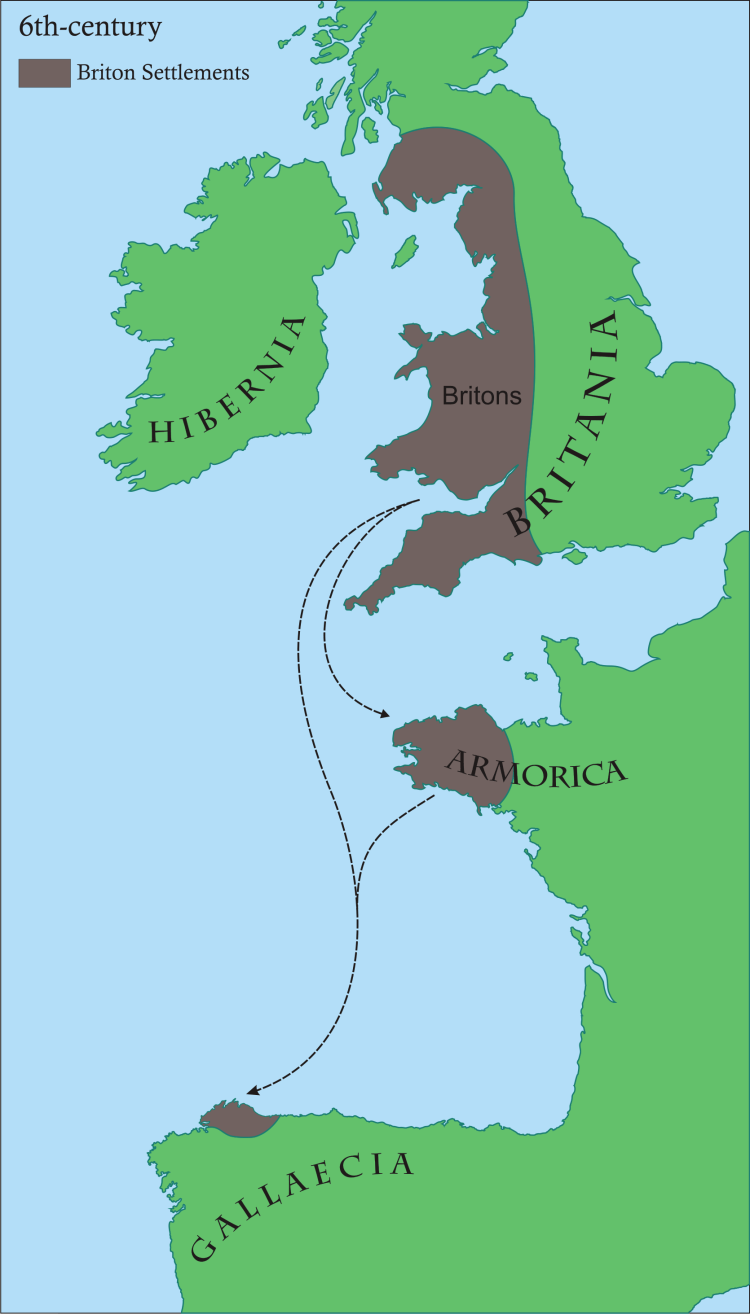
Briton settlements in the 6th century – settlements of the Angles, Saxons and Jutes in Britain, circa 600 In the following, Briton will refer to the Celtic Brittonic-speaking peoples who inhabited Britain south of the Firth of Forth, and who, following the arrival of the Anglo-Saxons in the 5th century, gradually retreated until the […]

 word histories