‘flexitarian’: meaning and origin
USA, 1992 (1981?)—adjective: primarily but not strictly vegetarian—noun: a person who follows a primarily but not strictly vegetarian diet—a blend of ‘flexible’ and ‘vegetarian’
Read More
“ad fontes!”
USA, 1992 (1981?)—adjective: primarily but not strictly vegetarian—noun: a person who follows a primarily but not strictly vegetarian diet—a blend of ‘flexible’ and ‘vegetarian’
Read MoreAustralia—a controversial current-affairs topic—the image is that such a topic is likely to interrupt a barbecue with loud debate—coined in 2001 by the Australian Prime Minister John Howard during his re-election campaign
Read Morewith reference to the Jewish prohibition of the eating of pork—‘as scarce as pork chops in a Jewish boarding house’ (USA, 1907) means ‘extremely rare’—‘like a pork chop in a synagogue’ (USA, 1915) means ‘out of place’; also ‘unwelcome’ or ‘unpopular’
Read More
Australia, 1980—a contented person—originated in advertisements for Vegemite, a type of savoury spread made from yeast extract and vegetable extract
Read More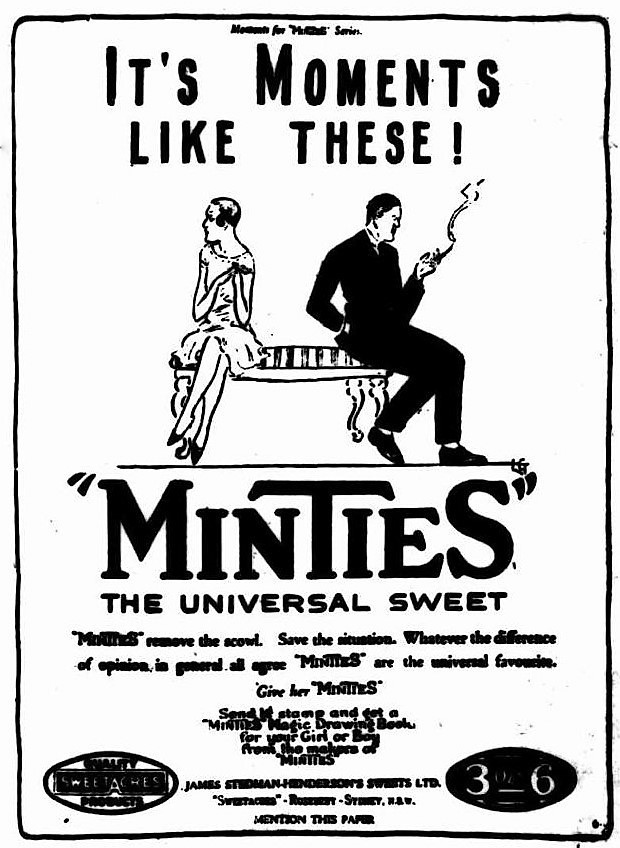
Australia, late 1920s—With reference to the slogan used in newspaper advertisements for Minties (peppermint-flavoured sweets), the phrase ‘it’s moments like these’ is applied to anyone in extremity, and the name ‘Mintie’ denotes a source of comfort.
Read MoreUSA, 2009—a party given for a man who is about to become a father, attended by men only—‘dadchelor’: a blend of ‘dad’ (i.e., ‘father’) and of ‘bachelor’ in ‘bachelor party’ (a party given for a man who is about to get married, attended by men only)
Read MoreAustralia, 1939—someone whose presence spoils things for others; an odd person out—of unknown origin—perhaps a variant of ‘gooseberry’, as in ‘to play gooseberry’—perhaps an alteration of ‘gripe’—perhaps related in some respect to ‘sour grapes’
Read MoreAustralia, 1985—Coined after ‘corkage’, the noun ‘cakeage’ denotes, in a restaurant, the cutting and serving of a cake that has been brought in by a customer from off the premises, hence also a charge levied for this service.
Read MoreUSA, 1927—denotes male vigour, especially sexual—with wordplay on ‘penis’—interestingly, via an alteration of the Latin diminutive ‘pēnĭcillus’, denoting literally a little tail, hence a painter’s brush or pencil, ‘pencil’ is derived from Latin ‘pēnis’, denoting literally a tail, hence the penis
Read Morean artist or writer who produces what is considered to be inferior work simply to earn a living—loan translation from German ‘Brotkünstler’—first used in 1827 by Scottish historian and political philosopher Thomas Carlyle in a text about German literature
Read More
