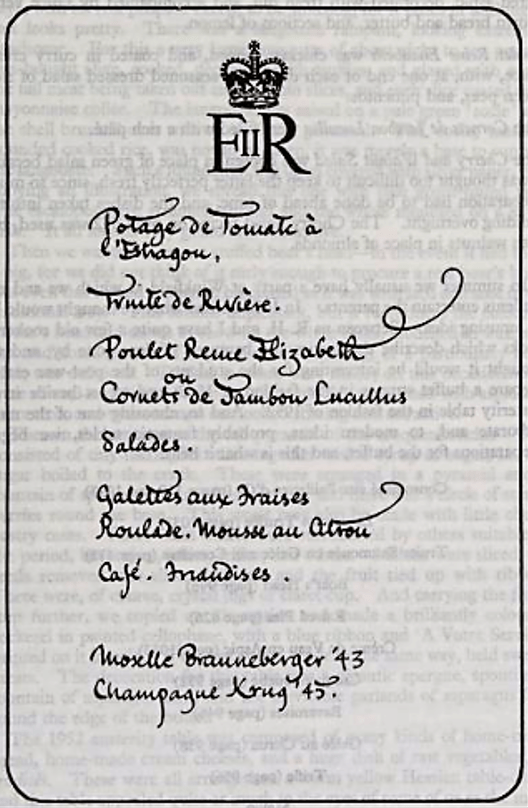
a dish of cold cooked chicken served in a mild creamy curry sauce—so named because created for a lunch held to mark the coronation of Queen Elizabeth II in June 1953, at which it was called ‘Poulet Reine Elizabeth’—also USA, April 1953: a dish created when the Poultry and Egg National Board organised Coronation Chicken Day
1922, slang of high-school and university students in Kansas City (Missouri) and in Kansas: a fashionable young man who enjoys socialising with women at tea parties or other social events—1924: a diplomat employed by the U.S. State Department, regarded as being excessively occupied with entertaining dignitaries and doing little meaningful work
USA, 2003—Following France’s opposition to the proposed U.S.-led invasion of Iraq, the expression ‘freedom fries’ was substituted for ‘French fries’. This, and other expressions in which ‘freedom’ was substituted for ‘French’, may have been coined almost simultaneously by various persons, independently from each other.
USA—of the French: (1954) a workday with a long midday break for a substantial meal and a sleep—of filmmaking in France: (1956) the workday, beginning at noon and without lunch break—of filmmaking in the USA: (2004) a workday without lunch break, during which food is constantly available
USA, 1966—a restaurant that features scantily-clad waitresses—especially associated with the restaurant chain Hooters—also: a woman who breastfeeds, or the breast of a woman who breastfeeds
U.S.A, 1932—also ‘the land of nuts and fruits’—a humorous, sometimes derogatory, appellation for the U.S. state of California—refers to California’s agricultural bounties and to Californians regarded as being ‘nuts’, i.e., crazy
UK, 1921—‘frogspawn’: a jocular appellation for ‘tapioca pudding’ (also for ‘sago pudding’)—originated in schoolchildren’s slang—refers to the fact that both tapioca pudding and sago pudding very much resemble frogspawn, i.e., a soft substance like jelly which contains the eggs of a frog
USA, 1975—to hastily or furtively leave a restaurant, cafe, etc., in order to avoid paying for one’s bill—also used as a noun, especially as a modifier—has also been used of meals eaten quickly
USA, 1992 (1981?)—adjective: primarily but not strictly vegetarian—noun: a person who follows a primarily but not strictly vegetarian diet—a blend of ‘flexible’ and ‘vegetarian’

 word histories