Witham is the name of several villages in Lincolnshire and Essex. With a pun on wit, the expression little, or small, Witham was used proverbially for a place of which the inhabitants were remarkable for stupidity. For example, the following, from A fourth hundred of epygrams (1560) by the English playwright and epigrammatist John Heywood […]
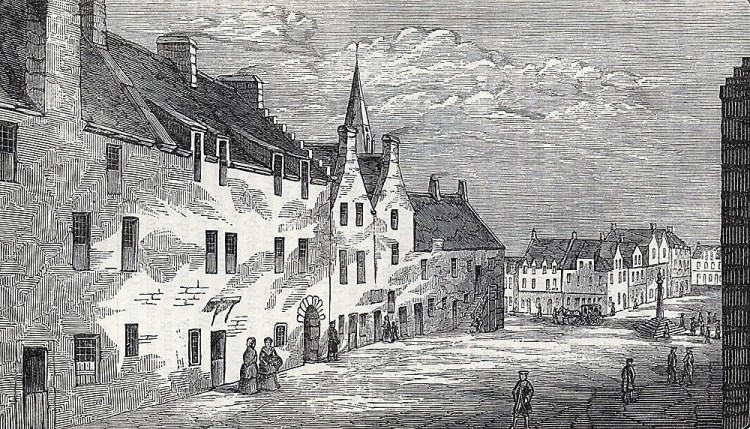
the Rotten-row in Glasgow, circa 1570 image: The Glasgow Story The street name Rotten Row occurs in many different towns. For example, The Caledonian Mercury (Edinburgh) of 10th December 1728 published the following advertisement: There is just come to Leith, a Parcel of fine Figs both in Casks and Frails [= baskets], […]
A drawing of Peeping Tom, in the exact state in which he is carved, but divested of all paint and superfluous ornaments. W. Reader in The Gentleman’s Magazine: and Historical Chronicle (London) of July 1826 The Coventry Peeping Tom statue, which dates from around 1500, survives today. Though it is now stripped down to […]
Nowadays, a curfew is a regulation requiring people to remain indoors between specified hours, typically at night – for example: a dusk-to-dawn curfew. The word is from Old French and Anglo-Norman forms such as cuevre-feu and covrefeu, hence the Modern French word couvre-feu (plural couvre-feux), composed of: – couvre, imperative of the verb couvrir, to cover, – feu, meaning fire. The corresponding medieval Latin names were ignitegium […]
The word pedigree appeared in the early 15th century in the Latin form pedicru and in English forms such as pe-de-grew and pedegru, from Anglo-Norman French pé de grue and variants (pied de grue in Modern French), meaning literally foot of crane. The Anglo-Norman French word is first recorded during the second Michaelmas term (i.e. during the second session, beginning soon after Michaelmas, of the […]
MEANING a heavy cotton pile fabric with lengthways ribs ORIGIN: UNKNOWN The original form of this noun, in the late 18th century, was corderoy. The earliest use of the word that I have found is from The Manchester Mercury (Manchester, Lancashire, England) of Tuesday 7th April 1772: […]
MEANING a man unduly concerned with looking stylish and fashionable ORIGIN As it was originally in use on the Scottish Border at the end of the 18th century, dandy represents perhaps the name Andrew. (From Dandie Dinmont (i.e. Andrew Dinmont), the name of a character in Guy Mannering; or, The Astrologer (1815), […]
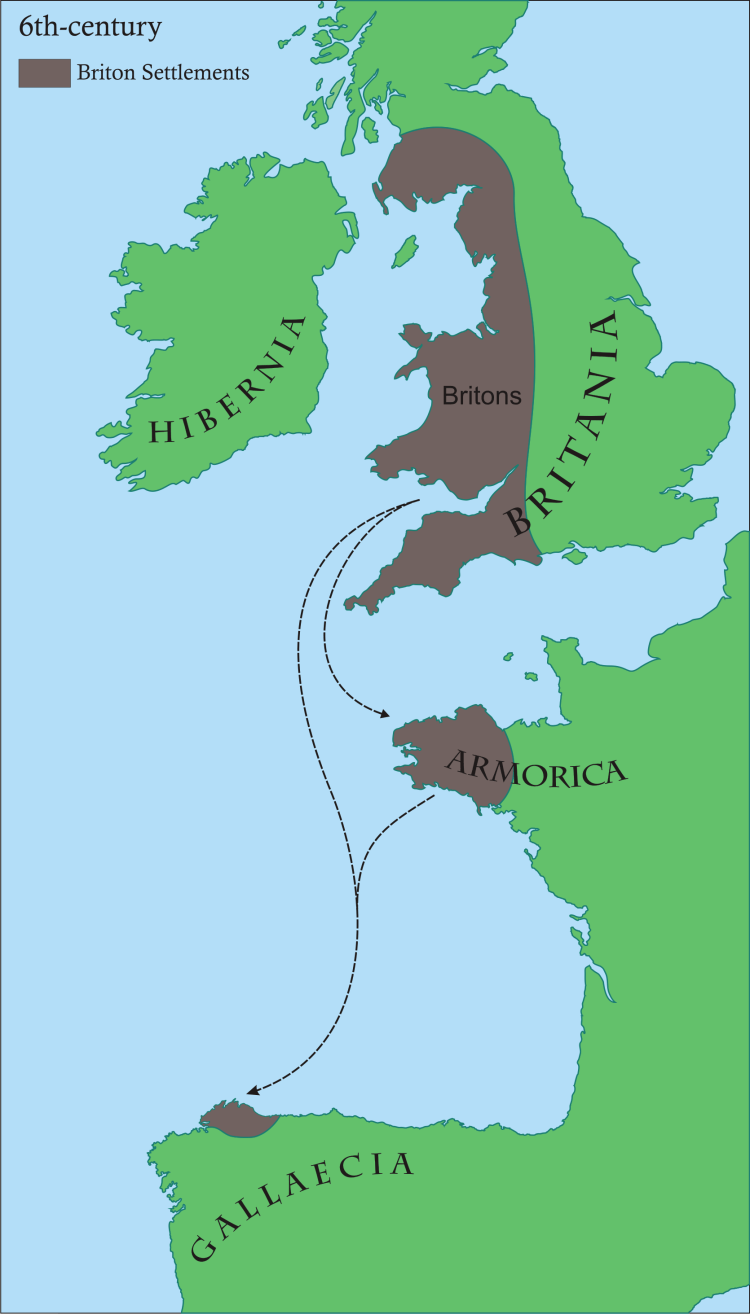
Briton settlements in the 6th century – settlements of the Angles, Saxons and Jutes in Britain, circa 600 In the following, Briton will refer to the Celtic Brittonic-speaking peoples who inhabited Britain south of the Firth of Forth, and who, following the arrival of the Anglo-Saxons in the 5th century, gradually retreated until the […]
The Anglo-Saxons were the Germanic inhabitants of England before the Conquest, i.e. the invasion and assumption of control by William of Normandy in 1066. Known as William the Conqueror, William I (circa 1027-87) defeated Harold II at the Battle of Hastings. He introduced Norman institutions and customs, including feudalism, and instigated the Domesday Book. […]
The phrase ‘a pretty kettle of fish’ originally referred to a net full of fish, which, when drawn up with its contents, is suggestive of confusion, flurry and disorder—‘kettle’ being a form of ‘kiddle’, a noun denoting a dam or other barrier in a river, with an opening fitted with nets to catch fish.



 word histories