the origin of ‘spud’ (potato)
The noun ‘spud’, originally the name for the digging implement used to dig up potatoes, was applied to the latter in the 19th century.
Read More
“ad fontes!”
The noun ‘spud’, originally the name for the digging implement used to dig up potatoes, was applied to the latter in the 19th century.
Read More
early 17th century, with ‘the Dead Sea’ and ‘the deep sea’—originated in the image of a choice between damnation (‘the Devil’) and drowning (‘the sea’)
Read Morerefers to a person making a pact with the Devil: the heavy price has to be paid in the end—unrelated to the nautical phrase ‘the devil to pay and no pitch hot’
Read Morelate 17th century—probably based on the resemblance between the shape of the heart and that of a cockleshell – or of the body the shell protects
Read More
UK, 1915—humorous blend of the common noun ‘mummer’ and of the name ‘Somerset’—denotes a pseudo-rustic dialect used by actors and an imaginary rustic county.
Read More1696—perhaps from ‘latet anguis in herba’ (a snake hides in the grass) in Virgil’s Eclogues—cf. ‘a pad [= toad] in the straw’ and French ‘il y a de l’oignon’
Read More
late 1910s: an answer to an enquiry as to the whereabouts of someone who cannot be found—1930s: the space at the top of the dartboard where scores are doubled
Read Moreattested 1699—from the hyperbolical phrase ‘to skin a flint’ (1656)—cf. ‘to skin a flea for its hide and tallow’ and French ‘tondre un œuf’ (‘to shave an egg’)
Read More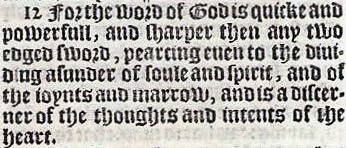
to serve both sides of an argument; to have both good and bad effects—England, early 18th century—refers to a sword which has two cutting edges
Read More
1790—from the name of a Quaker who must prove his identity against an impostor’s claims in ‘A Bold Stroke for a Wife’ (1718), a comedy by Susanna Centlivre
Read More word histories