also, and originally (1729), ‘to make a long story short’: to be brief or concise—this phrase is typically used as a sentence adverbial, with the sense: in short, in summary, briefly
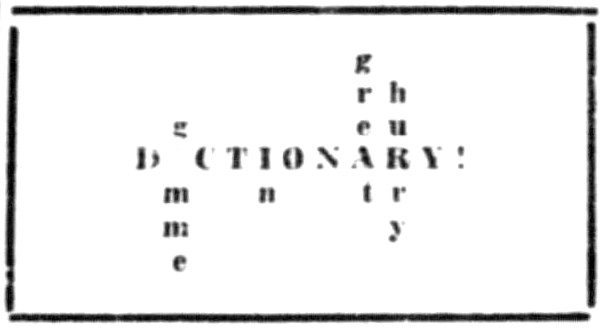
the style of language considered characteristic of crossword clues or solutions—USA, 1925—from the noun ‘crossword’ and the suffix ‘-ese’, forming nouns designating the style of language considered characteristic of the first element
late 18th century, in the context of piracy: to walk along a plank placed over the side of a ship until one falls into the sea—hence, figuratively, early 19th century: to be forced to resign from one’s office or position
nonsense, rubbish—USA, first decade of the 20th century—probably a euphemism for the noun ‘bullshit’, with the noun ‘dust’ used in the sense of ‘rubbish’, ‘garbage’
literally (1845): an enclosure in which calves are isolated from their mothers until weaned—figuratively, humorously and offensively (1885): a girls’ boarding-school—similar to the use of ‘cow’ to derogatorily designate a girl or woman
early 19th century—pandemonium, great trouble or difficulty—often in ‘to kick up hell’s delight’, meaning: to cause a great deal of trouble or difficulty
a social occasion where the host gets drunk at an earlier time than the guests—1682?—one of several expressions in which the adjective ‘Dutch’ is used derogatorily or derisively
1910—a humorous phonetic transcription of the phrase “goes into”, as originally used at school in arithmetic lessons (as in “4 guzinter 8 two times”)—hence, by extension: a schoolteacher

 word histories