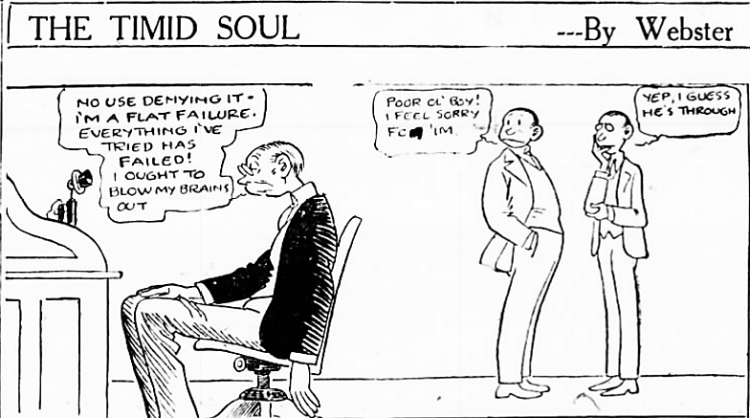
NO USE DENYING IT – I’M A FLAT FAILURE. EVERYTHING I’VE TRIED HAS FAILED! I OUGHT TO BLOW MY BRAINS OUT POOR OL’ BOY! I FEEL SORRY FOR ’IM YEP, I GUESS HE’S THROUGH THAT NIGHT TELEGRAPH OFFICE? I WANT TO SEND A WIRE TO STATION B-L-A-H, 164 BLANK ST. – YOUR CONCERT COMING […]
the gods at the Comedy Theatre, London, 1949 source: Historic England – The Theatres Trust Via Middle French galerie, the noun gallery, attested in the late 15th century, is from the medieval Latin of Italy galeria, an alteration of medieval Latin galilaea, designating a porch at the entrance of a monastery’s church—hence English […]
Four’s a Crowd.—A merry, irresponsible farce that dips frequently into pure crazy comedy. For this they have chosen to give Errol Flynn and Olivia de Havilland a “break” from their usual story book hero and heroine types. These two lovely young people do very well, but I cannot think that crazy comedy suits them best. […]
The phrase like a cat on hot bricks and its American-English equivalent like a cat on a hot tin roof mean very agitated or anxious. An earlier form of the phrase was recorded by the English naturalist and theologian John Ray (1627–1705) in A Collection of English Proverbs (2nd edition – 1678): To go like […]
MEANING The phrase (if you’ll) excuse (or pardon) my French is used as an apology for swearing. ORIGIN The current sense seems to derive from an actual apology for speaking French. (It is therefore unnecessary to invoke the centuries-old adversarial relationship between the English and the French.) The form pardon my French is first attested in Randolph, a Novel (1823), by the American […]
MEANING a young man paid or financially supported by a woman, typically an older woman, to be her escort or lover ORIGIN In English, gigolo originally denoted a professional male dancing-partner. One of its first users was the American novelist, short story writer and playwright Edna Ferber (1885-1968) in Gigolo, which was published in […]



 word histories