A calque of German ‘blauer Montag’, ‘blue Monday’ originally denoted a Monday on which people chose not to work as a result of excessive indulgence over the course of the weekend. Under the influence of the adjective ‘blue’ in the sense ‘dismal’, it came to denote a Monday that is depressing or trying.
‘happy-clappy’: a member of a Christian group whose worship is marked by enthusiastic participation; composed of ‘happy’ and of the noun ‘clap’ suffixed with ‘-y’—with allusion to the cheerful singing and hand-clapping regarded as typical of charismatic religious services
The phrase ‘to turn up one’s toes’, meaning ‘to die’, might have originated in the Irish-English phrase ‘to turn up one’s toes to the roots of the daisies’, first found in the passive form ‘with one’s toes turned up to the roots of the daisies’, meaning ‘lying dead’.
Many centuries before becoming a nickname for New York City and the name of a fictional city associated with the Batman stories, Gotham was used in Britain as the name of a (probably fictional) village proverbial for the folly of its inhabitants.
The phrase to chop and change means to change one’s opinions or behaviour repeatedly and abruptly. Here, chop originally meant to barter, and change meant to make an exchange with; in other words, this was an alliterative repetitive expression, the two verbs having roughly the same meaning (cf. also, for example, the alliterative phrase to be part and […]
‘Hobby’, diminutive of ‘Hob’, pet form of ‘Robert’, was used to denote a small horse, hence a child’s toy with a horse’s head, hence a favourite occupation—cf. French ‘dada’, child’s word for horse, used to denote a favourite pastime
Twelfth Day denotes the twelfth day after Christmas, i.e. 6th January, on which the festival of the Epiphany is celebrated, and which was formerly observed as the closing day of the Christmas festivities. (Epiphany denotes the festival commemorating the manifestation of Christ to the Gentiles in the persons of the Magi; via Old-French and Anglo-Norman forms such as epyphane (Modern […]
USA, 1948—espresso coffee mixed with steamed milk—borrowed from Italian ‘cappuccino’, literally ‘Capuchin’, because the colour of this type of coffee resembles that of a Capuchin’s habit—cf. French ‘capucin’ (= ‘Capuchin’), a name for the hare, from the colour of the animal’s fur
The name ‘Indian summer’ (late 18th century) reflected the fact that to the Europeans living in the New World, this was a newly-discovered local phenomenon. But similar phenomena were already known in the Old World by various names.
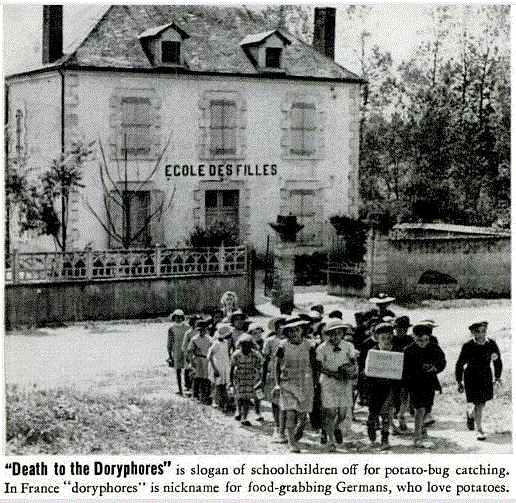
Greek ‘δορυϕόρος’ (‘doruphόros’) meant ‘spearman’; in French, ‘doryphore’ denotes the Colorado beetle and the German occupying forces during WWII; in English, it denotes a pedantic and annoyingly persistent critic.