to engage in pointless or futile activity in the face of disaster—USA, 1969—apparently first used, and perhaps coined, by Elizabeth Carpenter, press secretary for the wife of President Lyndon B. Johnson
American English, 1874—used in particular of stupidity, as in ‘dumb as a bag of hammers’ and variants—the underlying notion is probably that anything is dumb that does all the hard work
the principle that, where an effective legal system is absent or does not apply, brute strength and self-interested ruthlessness are what determine success, ownership, etc.—USA, 1878—predates Kipling’s Jungle book
UK, late 1980s—the adverb ‘o’clock’ is colloquially and humorously used with adjectives to denote an unreasonably, excessively or inconveniently early or late hour—as in ‘stupid o’clock’, ‘silly o’clock’, etc.
one’s feet as a means of travel, humorously represented as a form of public transport—from 1887 onwards in the southeastern states of Georgia and Alabama
USA, early 1930s—adjectives—‘little-girl-lost’: resembling (that of) a small girl who has lost her way—‘little-boy-lost’: resembling (that of) a small boy who has lost his way
one who sews up wounds, i.e., a surgeon—also, in later use, a plastic surgeon—first recorded in ’Tis Pitty Shee’s a Whore (1633), by the English playwright John Ford
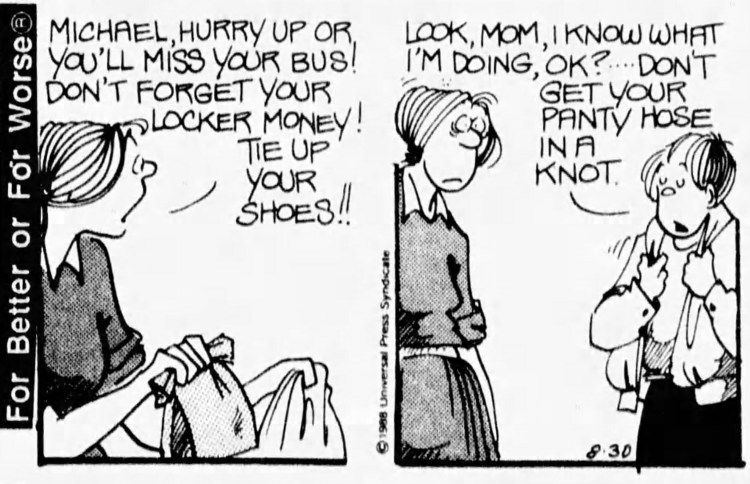
also ‘in a wad’, ‘in a knot’, etc.—to become unduly agitated or angry—the plural noun ‘panties’ refers to short underpants worn by women or girls—American English, 1975
a Latin-American television soap opera—from American-Spanish ‘tele-’ (in ‘televisión’) and ‘novela’ (‘a novel’)—1959 in American Spanish, 1961 in American English

 word histories