the gods at the Comedy Theatre, London, 1949 source: Historic England – The Theatres Trust Via Middle French galerie, the noun gallery, attested in the late 15th century, is from the medieval Latin of Italy galeria, an alteration of medieval Latin galilaea, designating a porch at the entrance of a monastery’s church—hence English […]
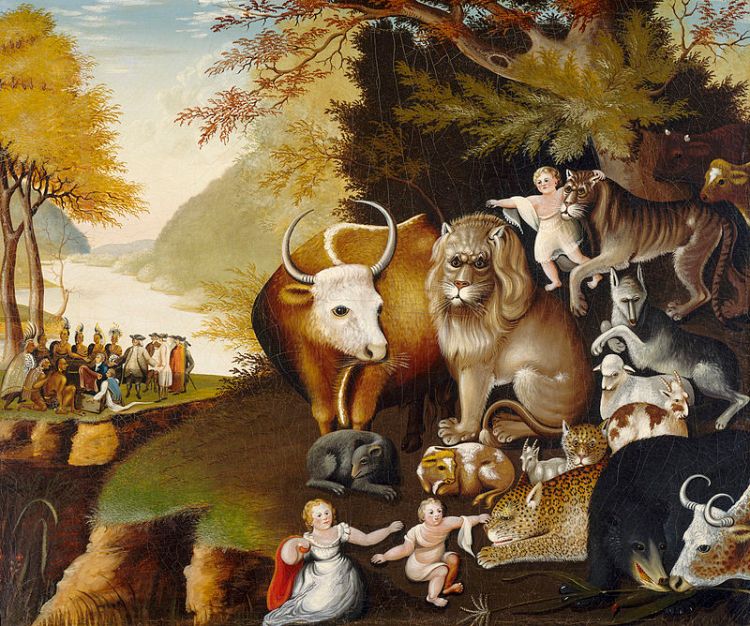
one of the versions of The Peaceable Kingdom (circa 1834), by Edward Hicks image: National Gallery of Art (Washington DC) The expression peaceable kingdom, in the sense of a state of harmony among all creatures as prophesied in the Book of Isaiah, 11:1-9, first appeared in the King James Version (1611): […]
Pig meat has traditionally been a staple food; this is illustrated by this French saying: Dans le cochon tout est bon, De la queue jusqu’au menton. translation: In the pig all is good, From the tail to the chin. However, in French as in English, many pig idioms are derogatory; for example: – avoir […]
photograph: Google+ Communities The noun philtrum denotes the vertical groove between the base of the nose and the border of the upper lip. The literal and obsolete signification of this word, which appeared in the early 17th century, is love potion, from classical Latin philtrum, of same meaning. In post-classical Latin, philtrum came to also denote the dimple in the upper lip. It […]
The noun cruse denotes a small earthenware vessel for liquids. It is of Germanic origin and related to words such as Dutch kroes and Swedish krus, of same meaning. The expression widow’s cruse signifies an apparently small supply that proves inexhaustible. It is an allusion to the First Book of Kings, 17. The prophet Elijah has been fed by ravens and has drunk from a […]
The phrase (as) cold as charity refers to the perfunctory, unfeeling manner in which acts of charity are often done, and public charities administered. It originally alluded to the gospel of Matthew, 24:12, which is as follows in the Early Version (around 1382) of the Wycliffe Bible (wexe is the verb wax and means become, […]
“I think we may say everything’s more or less oojah-cum-spiff. With one exception, Jeeves,” I said, a graver note coming into my voice as I gave Gus his second helping of kipper. “There remains a fly in the ointment, a familiar saying meaning—well, I don’t quite know what it does mean. It seems to […]
The phrase the right hand does not know what the left hand is doing and variants express unawareness, or (deliberate) ignorance, of one’s own activities. This phrase is now mainly used to convey that there is a state of confusion within a group or organisation. But, in early use, it was an injunction to be discreet in […]
The Latin noun lupus/-pi meant wolf. It is kindred with ancient Greek λύκος (lukos). —Cf. lycanthrope, which originally designated a person who believes that he or she is a wolf, and which, via the modern Latin noun lycanthrōpus, is from Greek λυκάνθρωπος (lukanthropos), literally wolf-man, from λύκος and ἄνθρωπος (anthropos), man. The Latin lupus has sometimes been used in English in the sense of wolf; for instance, a Scottish […]
MEANING a member of a family or group who is regarded as a disgrace to it ORIGIN This was perhaps originally an allusion to the book of Genesis, 30. Jacob has already worked fourteen years for both of Laban’s daughters, and after Joseph’s birth he desires to take leave of Laban. They reach […]



 word histories