In The Tragedie of Macbeth (around 1603), by the English poet and playwright William Shakespeare (1564-1616), Gray-Malkin is the name of a fiend in the shape of a grey she-cat, the cat being the form most generally assumed by the familiar spirits of witches according to a common superstition: (Folio 1, 1623) […]
The adjective fed up means annoyed, unhappy or bored, especially with a situation that has existed for a long time. The original, literal meaning is simply sated with food, since to feed up an animal or a person is to supply them with rich and abundant food. For example, the author of Whether Love be a natural or fictitious Passion, published in Pope’s Bath Chronicle of 3rd May 1764, wrote: The […]
MEANING to pay excessively, to be charged exorbitantly PROBABLE ORIGIN The expression to pay through the nose is first recorded in Piazza universale di proverbi Italiani, or, A common place of Italian proverbs and proverbial phrases digested in alphabetical order (1666), by Giovanni Torriano (floruit 1640): Oft-times Rich men engrossing commodities, will make one pay through the […]
A blend of magpie and piety, the word magpiety was originally invented by the English poet and humorist Thomas Hood (1799-1845) to denote talkativeness, garrulity, especially on religious or moral topics and affected piety. This author first used the word in Jarvis and Mrs. Cope, published in The New Sporting Magazine of March 1832; the poem thus begins: JARVIS AND MRS. COPE. A decidedly serious […]
The Latin noun lupus/-pi meant wolf. It is kindred with ancient Greek λύκος (lukos). —Cf. lycanthrope, which originally designated a person who believes that he or she is a wolf, and which, via the modern Latin noun lycanthrōpus, is from Greek λυκάνθρωπος (lukanthropos), literally wolf-man, from λύκος and ἄνθρωπος (anthropos), man. The Latin lupus has sometimes been used in English in the sense of wolf; for instance, a Scottish […]
MEANING a member of a family or group who is regarded as a disgrace to it ORIGIN This was perhaps originally an allusion to the book of Genesis, 30. Jacob has already worked fourteen years for both of Laban’s daughters, and after Joseph’s birth he desires to take leave of Laban. They reach […]
MEANING The phrase to be barking up the wrong tree means to be pursuing a mistaken or misguided line of thought or course of action—cf. also origin of ‘gone coon’. ORIGIN In Americanisms, Old and New. A Dictionary of Words, Phrases and Colloquialisms peculiar to the United States, British America, the West Indies, […]
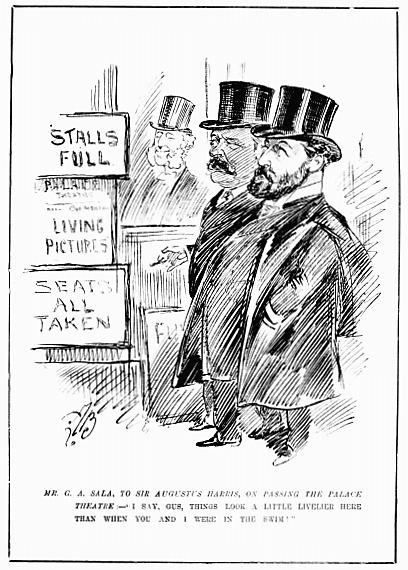
G. A. SALA, TO SIR AUGUSTUS HARRIS, ON PASSING THE PALACE THEATRE:—“I SAY, GUS, THINGS LOOK A LITTLE LIVELIER HERE THAN WHEN YOU AND I WERE IN THE SWIM!” — from The Entr’acte and Limelight (London) of 10th March 1894 (Augustus Harris (1825-73) was a British actor and theatre manager. George Augustus Sala (1828-95), was an […]
MEANING a single fortunate event doesn’t mean that what follows will also be good ORIGIN The annual migration of swallows to Europe from southern climes at the end of winter was the subject of a proverb in Ancient Greece: μία χελιδὼν ἔαρ οὐ ποιεῖ, in which ἔαρ means spring; it is found […]
In A Dictionarie of the French and English Tongues (1611), Randle Cotgrave gave the following definition of the French word gazette: A certaine Venetian coyne scarce worth our farthing; also, a Bill of Newes; or, a short Relation of the generall occurrences of the Time, forged most commonly at Venice, and thence dispersed, euery month, into most parts of Christendome. […]

 word histories