There are two Valentines, both Italian, one a priest and the other a bishop, who were martyred and used to be commemorated in the Roman Catholic calendar on 14th February. However, they have no romantic associations and the modern customs linked with St Valentine’s Day arise from a tradition according to which it is the day when the […]
Sir John Herschel The announcement last Friday of the death, at the age of 81, of the Rev. Sir John Herschel, Bart., which occurred at Observatory House, Slough, revives a host of memories of 18th century Bath. Sir John Herschel was the great-grandson of Sir William Herschel, the famous astronomer, who discovered from his scientific […]
The colloquial terms bag of mystery and mystery bag denote a sausage, a saveloy. The British lexicographer John Stephen Farmer (1854-1916) gave the following explanations in Slang and its Analogues Past and Present ([London]: Printed for subscribers only, 1890): Bags of mystery (common).—Sausages and saveloys are so called—from the often mysterious character of their compounds. Presumably composed […]
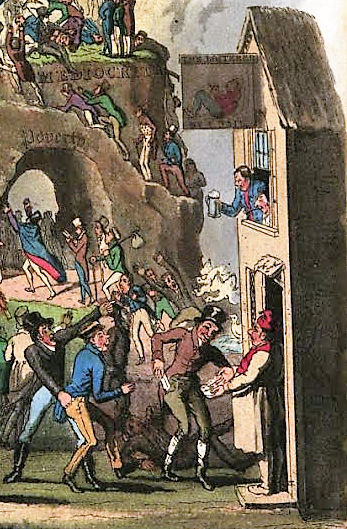
detail from the frontispiece to The Life of an Actor (1825), by Pierce Egan The phrase to get, or to give, the bird means to receive, or to show, derision, to be dismissed, or to dismiss. It originated in theatrical slang and referred to the ‘big bird’, that is, the goose, which hisses as people do when they make a sound of disapproval […]
The word ham denotes the part of the hindquarters of a pig or similar animal between the hock and the hip, hence, in cookery, the meat of this part, especially when salted or smoked. The comparison between large hands and hams (aided by the alliteration ham–hand) gave rise to the adjectives ham-fisted and ham-handed, which mean: – having large hands; – hence […]
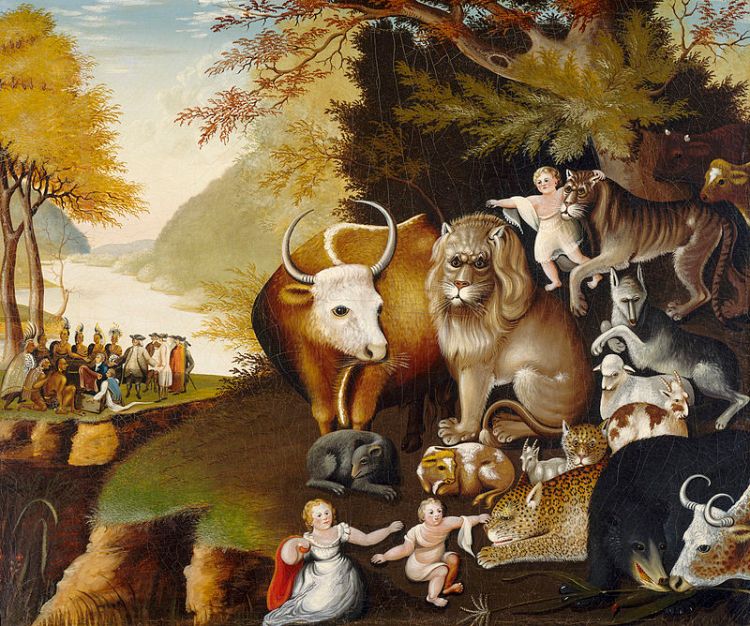
one of the versions of The Peaceable Kingdom (circa 1834), by Edward Hicks image: National Gallery of Art (Washington DC) The expression peaceable kingdom, in the sense of a state of harmony among all creatures as prophesied in the Book of Isaiah, 11:1-9, first appeared in the King James Version (1611): […]
Pig meat has traditionally been a staple food; this is illustrated by this French saying: Dans le cochon tout est bon, De la queue jusqu’au menton. translation: In the pig all is good, From the tail to the chin. However, in French as in English, many pig idioms are derogatory; for example: – avoir […]
‘To fight like Kilkenny cats’ means ‘to engage in a mutually destructive struggle’.—from the tale of two cats fighting until only their tails remained (early 19th century), which was originally meant to be nothing but amusing nonsense.
MEANING The phrase to kick the bucket means to die—synonym: to pop one’s clogs. ORIGIN What is nowadays considered a folk etymology may well be the true origin: to kick the bucket quite possibly refers to suicide by hanging after standing on an upturned bucket. For example, the following was published in Jackson’s Oxford […]



 word histories