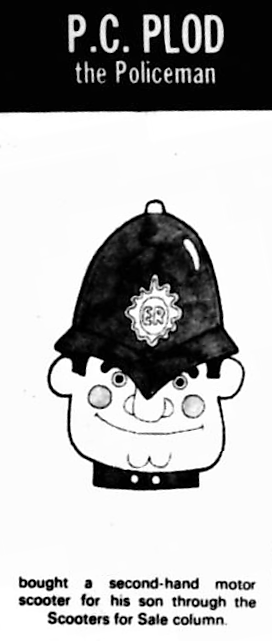
UK, 1963—‘Mr. Plod’, also ‘P.C. Plod’, ‘Plod’: a humorous or mildly derogatory appellation for a policeman or for the police—alludes to ‘Mr. Plod’, the name of the policeman in stories by the English author of children’s fiction Enid Blyton
UK, 1989—the practice of sending food destined for the British market for irradiation in a country, typically the Netherlands, where this process is permitted, in order to mask any bacterial contamination before it is put on sale—from ‘Dutch’ and the suffix ‘-ing’, forming nouns denoting an action
UK, WWII, army slang—‘spud-bashing’ (noun): potato-peeling; ‘spud-bash’ (verb): to peel potatoes; ‘spud-basher’ (noun): one who peels potatoes—those words have also been used with reference to potato-digging
Australia, 1950—a traffic warden in the state of New South Wales—‘brown’ probably refers to the colour of those traffic wardens’ uniform—‘bomber’ may refer to the fact that many of those traffic wardens were originally war veterans; or perhaps to the Australian-English use of the noun ‘bomb’ for an old car
USA—‘squillion’ (1879): an extremely large but unspecified number, quantity or amount; arbitrary and humorous alteration of ‘million’, ‘billion’, etc.—‘squillionaire’ (1895): a person who has an extremely large but unspecified amount of money
UK, 1899—derogatory—a foreigner; a personification of foreign people—‘Johnny’ is used with modifying word to designate a person of the type, group, profession, etc., specified



 word histories