‘perp walk’: meaning and origin
U.S. slang, 1986—a march into or out of a police car, courthouse, etc., that a person in police custody is made to perform for the benefit of the news media—‘perp’: shortening of ‘perpetrator’
Read More
“ad fontes!”
U.S. slang, 1986—a march into or out of a police car, courthouse, etc., that a person in police custody is made to perform for the benefit of the news media—‘perp’: shortening of ‘perpetrator’
Read MoreUK, 1822—a vituperative gossip, a scandalmonger; an evil or malicious tongue—a borrowing from French ‘mauvaise langue’ (literally ‘bad tongue’) of same significations
Read Moreone who rides a surfboard with the right foot forward instead of the left—USA, 1960 (as a verb)—here, ‘goofy’ seems to be related to prejudice against left-handedness and left-footedness
Read More1546—of little or no worth—here, ‘pudding’ refers to a sausage-like mass of seasoned minced meat, oatmeal, etc., stuffed into a prepared skin and boiled
Read More1666—a warning or exhortation to say nothing about a particular matter—of unknown origin—may allude to the mysterious nature of pudding stuffing
Read More1687—a lengthy and tedious reprimand—from the verb ‘job’ (1666), meaning: to reprimand in a long and tedious harangue—with allusion to the lengthy reproofs addressed to Job by his friends in the Book of Job
Read MoreUSA, 1937—informative material presented in an entertaining way at working-meetings (and later at other types of gatherings) organised by Shell Oil Company—a blend of ‘information’ and ‘entertainment’
Read Morealso, and originally (1729), ‘to make a long story short’: to be brief or concise—this phrase is typically used as a sentence adverbial, with the sense: in short, in summary, briefly
Read More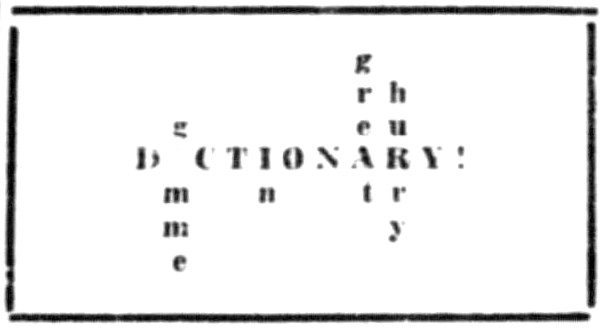
the style of language considered characteristic of crossword clues or solutions—USA, 1925—from the noun ‘crossword’ and the suffix ‘-ese’, forming nouns designating the style of language considered characteristic of the first element
Read Morelate 18th century, in the context of piracy: to walk along a plank placed over the side of a ship until one falls into the sea—hence, figuratively, early 19th century: to be forced to resign from one’s office or position
Read More word histories