The French term foie gras, from foie, liver, and gras, fat, fatty, denotes the liver of a specially fattened goose or duck prepared as food. Short for pâté de foie gras, it also denotes a smooth rich paste made from fatted goose or duck liver. Its first known use in English is in The Fudge […]
A drawing of Peeping Tom, in the exact state in which he is carved, but divested of all paint and superfluous ornaments. W. Reader in The Gentleman’s Magazine: and Historical Chronicle (London) of July 1826 The Coventry Peeping Tom statue, which dates from around 1500, survives today. Though it is now stripped down to […]
MEANING a place or state of utter confusion and uproar ORIGIN In Paradise Lost (1667), the English poet John Milton (1608-74) invented Pandæmonium, with a capital P, as the name for the capital of Hell, containing the council chamber of the Evil Spirits. This noun is from ancient Greek παν- (= pan-), […]
MEANING outside the limits of social convention ORIGIN The primary meanings of the noun pale are a wooden stake or post used with others to form a fence and a wooden fence made of stakes driven into the ground. This word appeared in the late 14th century and is from Anglo-Norman and Middle French pal, meaning a stake, a palisade, a […]
cover of The Great Panjandrum Himself (1885), a picture book based on the text attributed to Samuel Foote, by the English artist and illustrator Randolph Caldecott (1846-86) – photograph: Aleph-Bet Books MEANING a pompous self-important official or person of rank ORIGIN The word is supposed to have been coined in […]
Nowadays, a curfew is a regulation requiring people to remain indoors between specified hours, typically at night – for example: a dusk-to-dawn curfew. The word is from Old French and Anglo-Norman forms such as cuevre-feu and covrefeu, hence the Modern French word couvre-feu (plural couvre-feux), composed of: – couvre, imperative of the verb couvrir, to cover, – feu, meaning fire. The corresponding medieval Latin names were ignitegium […]
The word pedigree appeared in the early 15th century in the Latin form pedicru and in English forms such as pe-de-grew and pedegru, from Anglo-Norman French pé de grue and variants (pied de grue in Modern French), meaning literally foot of crane. The Anglo-Norman French word is first recorded during the second Michaelmas term (i.e. during the second session, beginning soon after Michaelmas, of the […]
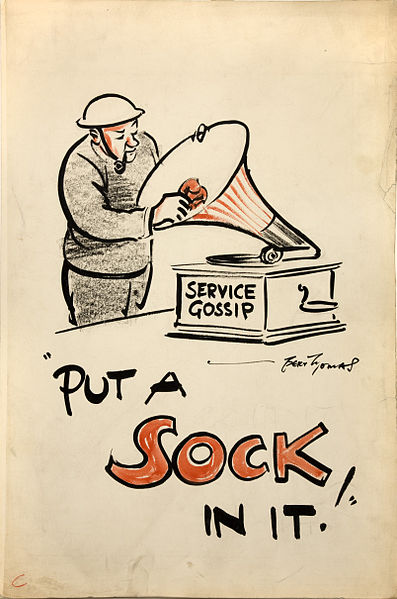
This cartoon by Bert Thomas (1883-1966) for the British Ministry of Information during World War II illustrates the folk etymology of the phrase. MEANING stop talking! ORIGIN The earliest known mention of this phrase is in a letter published by the London literary magazine The Athenæum of 8th August 1919: Sir, The […]
MEANING a persistent or desperate hope that is unlikely to be fulfilled, a faint hope, a ‘hope against hope’ ORIGIN On the face of it, this is a curious expression, because the adjective forlorn does not normally mean faint but miserable, lonely, forsaken or sad. The current sense of forlorn hope derives […]
The words man and mouse have been used in alliterative association in: – neither man nor mouse, to mean not a living creature, great or small, – mouse and man, or mice and men, to mean every living thing. The first known user of neither man nor mouse was the poet and writing-master John Davies […]