The phrase to carry coals to Newcastle means to supply something to a place where it is already plentiful; hence, figuratively, to do something wholly superfluous or unnecessary—cf. also to sell refrigerators to the Eskimos and to sell sand in the Sahara. This phrase (in which coals is an obsolete plural) refers to Newcastle upon Tyne, in […]
MEANING a young man paid or financially supported by a woman, typically an older woman, to be her escort or lover ORIGIN In English, gigolo originally denoted a professional male dancing-partner. One of its first users was the American novelist, short story writer and playwright Edna Ferber (1885-1968) in Gigolo, which was published in […]
It was only from the mere accident of his bearing the name that he did that the phrase ‘Hobson’s choice’ was applied to Thomas Hobson (1544-1631), an English liveryman who supposedly gave his customers no choice but to take the horse closest to the stable door or none at all. MEANING The […]
Donkey is a word of late appearance and of uncertain origin. It was first defined by the English antiquary and lexicographer Francis Grose (1731-91) in A Classical Dictionary of the Vulgar Tongue (1785): Donkey, donkey dick: a he, or jack ass, called donkey, perhaps from the Spanish or don-like gravity of that animal, entitled also the king […]
MEANING The phrase donkey’s years means a very long time. ORIGIN This expression is inseparable from donkey’s ears. In fact, these two expressions were originally a single one, donkey’s years being simply a dialectal pronunciation of donkey’s ears—or the other way around. And donkey’s ears/years (also donkeys’ ears/years) was part of a […]
MEANING The Northern Daily Mail and South Durham Herald (Hartlepool, County Durham, England) of 14th July 1894 published an article titled Naval Slang. How Jack Re-christens Things, which contains the following: The preserved meat served out to him is known as “Fanny Adams” or “Harriet Lane.” But the term Harriet Lane was also […]
The exclamation OMG expresses astonishment, excitement, embarrassment, etc. It is from the initial letters of oh my God (the final element may sometimes represent gosh or goodness). This initialism is older than the Internet or even the Usenet (an early computer network established in 1980), since it is first found in a letter that the […]
Buggins’ turn, or Buggins’s turn, is the principle of assigning an appointment to persons in rotation rather than according to merit. The earliest recorded use of this expression is in a letter written on 13th January 1901 by the British admiral Lord John Arbuthnot Fisher (1841-1920): Favouritism was the secret of our efficiency in the […]
MEANING to smell a rat: to detect something suspicious ORIGIN The first known use of this phrase is in The Image of Ipocrysy, an anonymous poem written around 1540, denouncing “the cruell clergy”: (published in 1843) Suche be owr [= our] primates, Our bisshopps and prelates, Our parsons and curates, With other […]
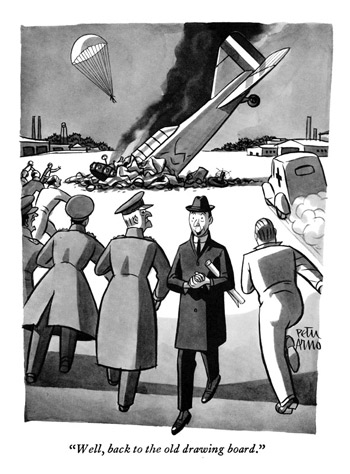
MEANING The phrase back to the drawing board is used to indicate that an idea, scheme or proposal has been unsuccessful and that a new one must be devised. ORIGIN This phrase originated in a cartoon by the U.S. cartoonist Peter Arno (Curtis Arnoux Peters, Jr – 1904-68), published in The New […]

 word histories