The word tennis in its current sense is short for lawn tennis. The original form of tennis (known as real tennis to distinguish it from the later lawn tennis) was played with a solid ball on an enclosed court divided into equal but dissimilar halves, the service side (from which service was always delivered) and […]
The word helpmate means a helpful companion or partner, especially one’s husband or wife. This noun was originally helpmeet, about which the New English Dictionary (i.e. the Oxford English Dictionary – 1901 edition) explained the following: A compound absurdly formed by taking the two words help meet in Genesis, ii, 18, 20 (‘an help meet […]
MEANING a woman who dresses or behaves in a way that is considered tasteless and sexually provocative ORIGIN John Camden Hotten defined this word in Dictionary of modern slang, cant, and vulgar words (1864 edition): a term of approval applied by the London lower orders to a young woman for whom some […]
The verb to sack (someone) means to dismiss (someone) from employment. This verb seems to have appeared in the first half of the 19th century. For example, the Perthshire Courier (Scotland) of Thursday 29th April 1841 reported that at the Glasgow assizes, during the trial for the murder of a superintendent of Railway labourers, one […]
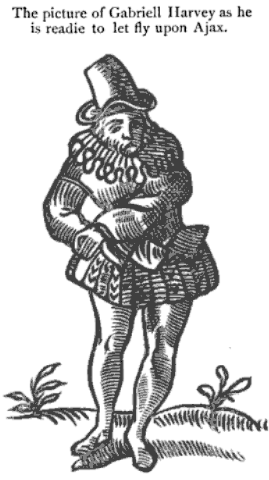
This word means a toilet, especially an outdoor one. The following is from A Dictionarie of the French and English Tongues (1611), by Randle Cotgrave: Retraict [modern French retrait]: masculine. An Aiax, Priuie, house of Office [= outdoor toilet]. It is a humorous respelling of a jakes, of same meaning, after Ajax, the name […]
Caricature of Gabriel Harvey from Haue with you to Saffron-walden. Or, Gabriell Harueys hunt is vp (1596), by Thomas Nashe. Entitled The picture of Gabriell Harvey as he is readie to let fly upon Ajax, this caricature depicts him rushing to the toilet at the thought of Nashe’s publication. Ajax was a pun on […]
The phrase from pillar to post means from one place to another in an unceremonious or fruitless manner. Its earliest recorded form is from post to pillar in The Assembly of Gods, an anonymous dream-vision allegory most likely written in the early fourth quarter of the 15th century (it was initially attributed to John Lydgate (1370-1449) […]
The noun ‘gongoozler’, denoting a person who stares protractedly at anything, originally designated an idler who stares at length at activity on a canal.
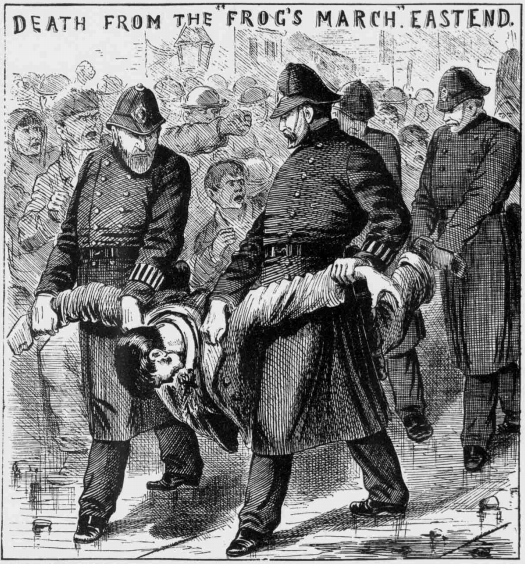
The verb to frog-march (somebody) means to force (somebody) to walk forward by holding and pinning their arms from behind. This sense is milder than the original, as the frog’s march was a police metaphor denoting a method of moving a resistant person such as a prisoner, in which he or she is lifted by […]
In early use, apple was a general term for all kinds of fruits other than berries, including even nuts. In fact, apple and berry are the only Anglo-Saxon fruit names, the rest being of Latin or ‘exotic’ origin. This is why apple was commonly used in describing foreign fruits, which explains for example the word […]



 word histories