The phrase tit for tat means an equivalent given in return or retaliation. The expression seems to be a variation of the obsolete and more comprehensible tip for tap, in which both tip and tap meant a light but distinct blow, stroke, hit. The phrase therefore meant blow for blow. The words tip and tap first appeared combined in Fortunes Stabilnes, by Charles d’Orléans (1394-1465). Context: the letter patent […]
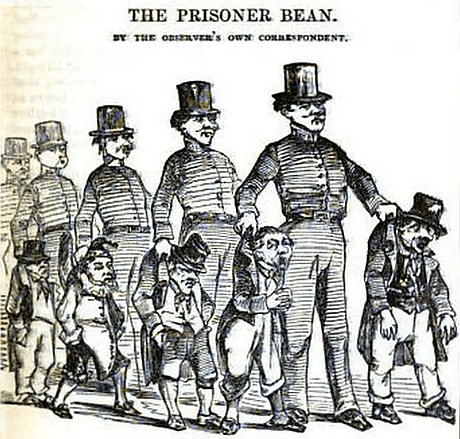
The term human bean is a humorous alteration or mispronunciation of human being, frequently used as part of an extended pun relating to beans. It is first recorded in Punch, or The London Charivari (1842): This little wretch is exciting the most intense interest, (Faugh!) and we have bribed the authorities in all directions to obtain information regarding him. It […]
The verb nail is used to mean to expose or reveal the falsehood of an allegation, assertion, etc., especially to prevent further dissemination. This use is first recorded in An Oration delivered at the Celebration in Philadelphia of the 106th Anniversary of the Birthday of Thomas Paine, by John Alberger, published in The North American […]
The noun myrmidon denotes a follower or subordinate of a powerful person, typically one who is unscrupulous or carries out orders unquestioningly. This word first appeared in the plural forms Mirmydanes and Murmindones in The Laud Troy book, a poem about the siege of Troy composed around 1400. It is from the classical Latin plural […]
The phrase to miss the bus, or the boat, etc., means to be too slow to take advantage of an opportunity. In A Concise Dictionary of Phrase and Fable (1993), B. A. Phythian explained: This expression is said to originate in an Oxford story of the 1840s about John Henry Newman, fellow of Oriel College, […]
“HUNS KILL WOMEN AND CHILDREN!” “TELL THAT TO THE MARINES!” First-World-War US recruiting poster by James Montgomery Flagg image: Disappearing Idioms This poster, which attracted a great deal of attention, portrays an angry-looking young man in the act of pulling off his coat as though he were anxious to get into a fight. The […]
Le Rhesus (Simia Rhesus) – illustration by Jean-Baptiste Audebert for his treatise, Histoire naturelle des singes et des makis (1799) – image: Bibliothèque nationale de France / gallica.bnf.fr This word is from French rhésus, formerly rhesus, and from its etymon, the scientific Latin (Simia) Rhesus. In Histoire naturelle des singes et des makis (Natural […]
The French phrase cherchez la femme, search for the woman, is used to indicate that the key to a problem or mystery is a woman, and that she need only be found for the matter to be solved. It first appeared as a catchphrase used by M. Jackal, a police detective, in Les Mohicans de Paris, […]
The phrase far from the madding crowd is used in reference to a private or secluded place. It is an allusion to An Elegy wrote in a Country Church Yard (published in 1751), by the English poet Thomas Gray (1716-71). When he composed this poem, Thomas Gray was living near St Giles’ parish church at Stoke Poges in Buckinghamshire. Meditating […]
The expression knight in shining armour denotes a person regarded as a medieval knight in respect of his chivalrous spirit, especially towards women. In A Concise Dictionary of Phrase and Fable (1993), B. A. Phythian explained: Despite its medieval feel, this is a twentieth-century phrase, first recorded in print in Victor Canning’s Whip Hand (1965). […]



 word histories