Nowadays, a curfew is a regulation requiring people to remain indoors between specified hours, typically at night – for example: a dusk-to-dawn curfew. The word is from Old French and Anglo-Norman forms such as cuevre-feu and covrefeu, hence the Modern French word couvre-feu (plural couvre-feux), composed of: – couvre, imperative of the verb couvrir, to cover, – feu, meaning fire. The corresponding medieval Latin names were ignitegium […]
The word pedigree appeared in the early 15th century in the Latin form pedicru and in English forms such as pe-de-grew and pedegru, from Anglo-Norman French pé de grue and variants (pied de grue in Modern French), meaning literally foot of crane. The Anglo-Norman French word is first recorded during the second Michaelmas term (i.e. during the second session, beginning soon after Michaelmas, of the […]
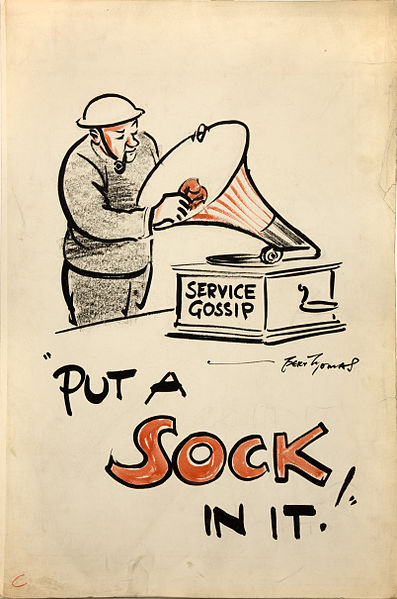
This cartoon by Bert Thomas (1883-1966) for the British Ministry of Information during World War II illustrates the folk etymology of the phrase. MEANING stop talking! ORIGIN The earliest known mention of this phrase is in a letter published by the London literary magazine The Athenæum of 8th August 1919: Sir, The […]
MEANING a persistent or desperate hope that is unlikely to be fulfilled, a faint hope, a ‘hope against hope’ ORIGIN On the face of it, this is a curious expression, because the adjective forlorn does not normally mean faint but miserable, lonely, forsaken or sad. The current sense of forlorn hope derives […]
The words man and mouse have been used in alliterative association in: – neither man nor mouse, to mean not a living creature, great or small, – mouse and man, or mice and men, to mean every living thing. The first known user of neither man nor mouse was the poet and writing-master John Davies […]
The phrase caviar to the general is used to denote a good thing unappreciated by the ignorant (here, the general refers to the multitude). It is from The Tragicall Historie of Hamlet, Prince of Denmarke (between 1599 and 1602), by the English poet and playwright William Shakespeare (1564-1616): (Quarto 2, 1604) – Hamlet: Come giue vs a tast of your quality, come […]
The Cheshire cat is now largely identified with the character in Alice’s Adventures in Wonderland (1865), by the English writer Lewis Carroll (Charles Lutwidge Dodgson – 1832-98): “Please would you tell me,” said Alice, a little timidly, for she was not quite sure whether it was good manners for her to speak first, “why your […]
MEANING a heavy cotton pile fabric with lengthways ribs ORIGIN: UNKNOWN The original form of this noun, in the late 18th century, was corderoy. The earliest use of the word that I have found is from The Manchester Mercury (Manchester, Lancashire, England) of Tuesday 7th April 1772: […]
In A Dictionary of the English Language (1755), the English lexicographer Samuel Johnson (1709-84) thus defined bonfire: [from bon, good, French, and fire.] A fire made for some publick cause of triumph or exultation. In support of this etymology, bonfire in several languages is, literally, fire of joy. For example: – French feu de joie – Italian fuoco d’allegrezza – German Freudefeuer – Dutch vreugdevuur. But […]
MEANING The following definition of budget is from the New English Dictionary (i.e. Oxford English Dictionary – 1888 edition): A statement of the probable revenue and expenditure for the ensuing year, with financial proposals founded thereon, annually submitted by the Chancellor of the Exchequer, on behalf of the Ministry, for the approval of the House […]


 word histories