In The English Struwwelpeter and the Birth of International Copyright (The Library, journal of the Bibliographical Society, 2013), Jane Brown and Gregory Jones explain that the ancient free city of Frankfurt am Main saw in 1845 the first appearance of Dr Heinrich Hoffmann¹’s Lustige Geschichten und drollige Bilder², a German children’s Christmas picture book. […]
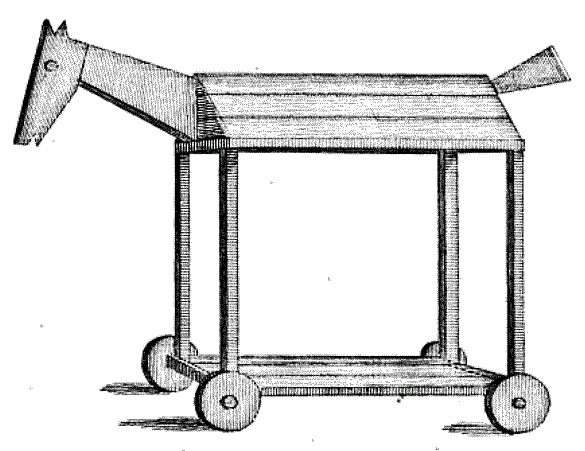
The phrase a horse that was foaled of an acorn denoted the gibbet, sometimes also called triple tree. In A Collection of English Proverbs (1678), the English naturalist and theologian John Ray (1627-1705) wrote: You’ll ride on a horse that was foal’d of an acorn. That is the gallows. Pelham; or, The Adventures […]
MEANING of payments: without delay ORIGIN This expression refers to the fingernail and might originally have alluded to drinking fair and square. A clue might be provided by the French phrase payer rubis sur l’ongle (literally to pay ruby on the fingernail), which means to pay exactly what is due. (A variant, used by prostitutes, was rubis sur pieu, […]
The Ranz des Vaches – from A Complete Dictionary of Music (1779) The term ranz-des-vaches denotes a type of Swiss melody, traditionally played on the Alpenhorn or sung in order to call cows scattered over the mountainside. The melody is characterised by the reiteration of short phrases and usually contains an element […]
The expression short shrift means brief and unsympathetic treatment, and to make short shrift of means to dispose of quickly and unsympathetically. A short shrift was originally a brief space of time allowed for a criminal to make his or her confession before execution. The expression is first recorded in The Tragedy of King Richard […]
MEANING any plant of the European genus Reseda, including mignonette and dyer’s rocket, which has small spikes of greenish, yellowish or whitish flowers ORIGIN Through translations of Naturalis Historia (Natural History – 77), a vast encyclopaedia of the natural and human worlds by the Roman statesman and scholar Pliny the Elder […]
Witham is the name of several villages in Lincolnshire and Essex. With a pun on wit, the expression little, or small, Witham was used proverbially for a place of which the inhabitants were remarkable for stupidity. For example, the following, from A fourth hundred of epygrams (1560) by the English playwright and epigrammatist John Heywood […]
Unexpectedly, the words fawn, meaning a young deer in its first year, and fetus (or foetus), meaning an unborn or unhatched offspring of a mammal, are doublets: they go back to the same etymological source but differ in form and meaning. While fetus has remained identical to this source, the form fawn is the result of sound changes—cf. also turban – tulip, clock – cloak, […]
Among other figurative meanings, the adjective thick has the sense of close in confidence and association, intimate, familiar. In Literary Anecdotes of the Eighteenth Century, published in 1812, John Nichols quoted Edmund Law (1703-87), Bishop of Carlisle: “Yes,” said he, “we begin now, though contrary to my expectation, and without my seeking, to be pretty thick; and I thank God, who reconciles me to […]
The phrasal verb shell out means to pay a specified amount of money, especially one regarded as excessive. It is first recorded in Moral tales for young people (1801), by the Anglo-Irish novelist and educationist Maria Edgeworth (1768-1849): “One of you, it’s plain, must shell out your corianders.” (The word coriander (or coliander), short for coriander-seed (or coliander-seed), was slang for coin, money. The form coliander-seed, […]



 word histories