meanings and origin of ‘blarney’

‘blarney’: originally an allusion to the lies told by those who, having not reached the Blarney stone (in a castle near Cork), explained how they did reach it
Read More
“ad fontes!”
‘blarney’: originally an allusion to the lies told by those who, having not reached the Blarney stone (in a castle near Cork), explained how they did reach it
Read More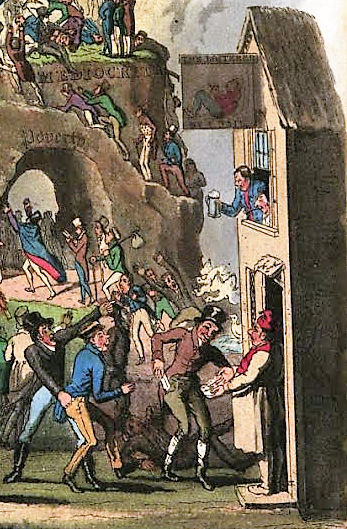
detail from the frontispiece to The Life of an Actor (1825), by Pierce Egan The phrase to get, or to give, the bird means to receive, or to show, derision, to be dismissed, or to dismiss. It originated in theatrical slang and referred to the ‘big bird’, that is, the goose, which hisses as people do when they make a sound of disapproval […]
Read MoreThe word ham denotes the part of the hindquarters of a pig or similar animal between the hock and the hip, hence, in cookery, the meat of this part, especially when salted or smoked. The comparison between large hands and hams (aided by the alliteration ham–hand) gave rise to the adjectives ham-fisted and ham-handed, which mean: – having large hands; – hence […]
Read More
The white cliffs of Dover— to which the name Albion did not originally refer [cf. note]. (photograph: Wikimedia Commons/Fanny) The name Albion first appeared in English in the very first sentence of the first Book of the 9th-century translation of Historia ecclesiastica gentis anglorum (The Ecclesiastical History of the English People) originally written by the English monk, […]
Read More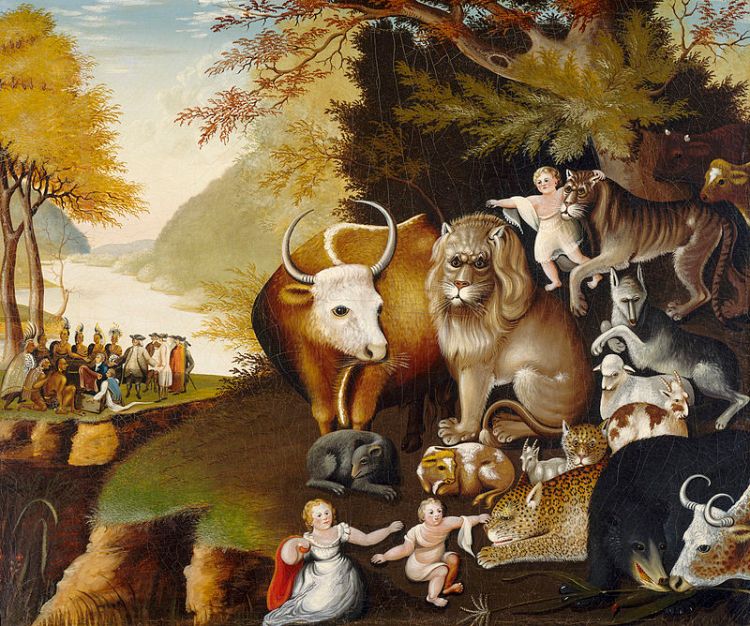
one of the versions of The Peaceable Kingdom (circa 1834), by Edward Hicks image: National Gallery of Art (Washington DC) The expression peaceable kingdom, in the sense of a state of harmony among all creatures as prophesied in the Book of Isaiah, 11:1-9, first appeared in the King James Version (1611): […]
Read MorePig meat has traditionally been a staple food; this is illustrated by this French saying: Dans le cochon tout est bon, De la queue jusqu’au menton. translation: In the pig all is good, From the tail to the chin. However, in French as in English, many pig idioms are derogatory; for example: – avoir […]
Read More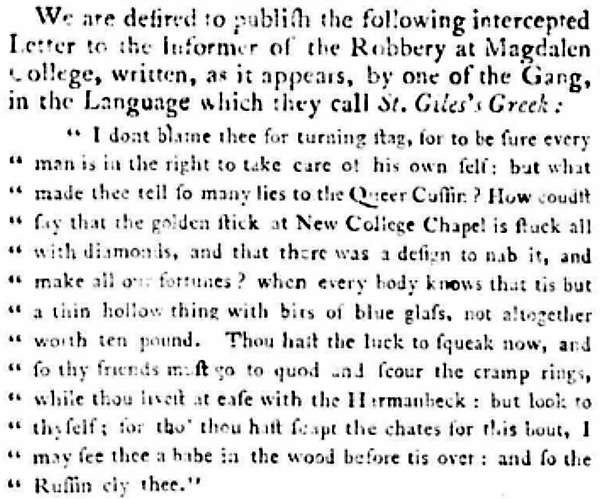
The noun Greek has long been used in the sense of unintelligible speech or language, gibberish, and the phrase it’s (all) Greek to me means I can’t understand it at all. This expression is well known from The Tragedie of Julius Cæsar (1599), by the English playwright and poet William Shakespeare (1564-1616): (Folio […]
Read More
“Tell me, man, how goes the enemy?” cartoon published in the Sunday Pictorial (London) of 23rd August 1942 The colloquial phrase How goes the enemy? means What is the time?. Its origin was explained in the text where it is first recorded, published in the Brighton Gazette, and Lewes Observer (Sussex) of 26th October 1826: THE VAMPIRE. N° LVIII. My dear […]
Read MoreThe adjective teetotal in the sense of choosing, or characterised by, total abstinence from all alcohol seems to have first been used about September 1833 by Richard Turner, a worker from Preston, Lancashire, in a speech advocating total abstinence from intoxicating liquors, in preference to abstinence from ardent spirits only (as practised by some early […]
Read MoreThe word cheese is from Old English cēse, cȳse, of West-Germanic origin; it is related to its Dutch and German equivalents kaas and Käse respectively. Those words are ultimately derived from Latin caseus, cheese, which is also the origin of: – Spanish queso – Portuguese queijo – regional Italian cacio – Romanian: caș. Based on […]
Read More word histories