The proverb you can’t make a silk purse out of a sow’s ear means you can’t create a fine product from inferior materials. It originated in Scotland, according to its first recorded instance, in A New Dictionary of the Terms Ancient and Modern of the Canting Crew (1699), by “B. E. Gent.”: Luggs, Ears: Hence […]
The phrase (as) cold as charity refers to the perfunctory, unfeeling manner in which acts of charity are often done, and public charities administered. It originally alluded to the gospel of Matthew, 24:12, which is as follows in the Early Version (around 1382) of the Wycliffe Bible (wexe is the verb wax and means become, […]
The expression cold comfort means inadequate consolation for a misfortune. The adjective cold has long been used to mean felt as cold by the receiver, chilling, damping, discouraging. For example, the English poet Geoffrey Chaucer (circa 1342-1400) wrote, in The Nun’s Priest’s Tale: (interlinear translation – Harvard College) Wommennes conseils been ful ofte colde; Women’s counsels […]
MEANING The phrase (straight) from the horse’s mouth refers to information and means from the person directly concerned or another authoritative source. ORIGIN This phrase is from horse racing, and alludes to the presumed ideal source for a racing tip. The earliest instance that I have found is from Bell’s Life in […]
Frequently used in the passive, the phrase to sell someone a pup means to swindle someone, especially by selling something of little worth on its supposed prospective value. And to buy a pup means to be swindled. The expression is first recorded in 1901. That year, several newspapers gave its most likely origin; for example, the column From Day to Day of The Daily […]
A blend of breakfast and lunch, the noun brunch denotes a late morning meal eaten instead of breakfast and lunch. It originated, apparently in the late 19th century, as Oxford University slang and is first recorded in Lunch at Oxford, by Margaret B. Wright, published in The Independent (New York City, New York, USA) of […]
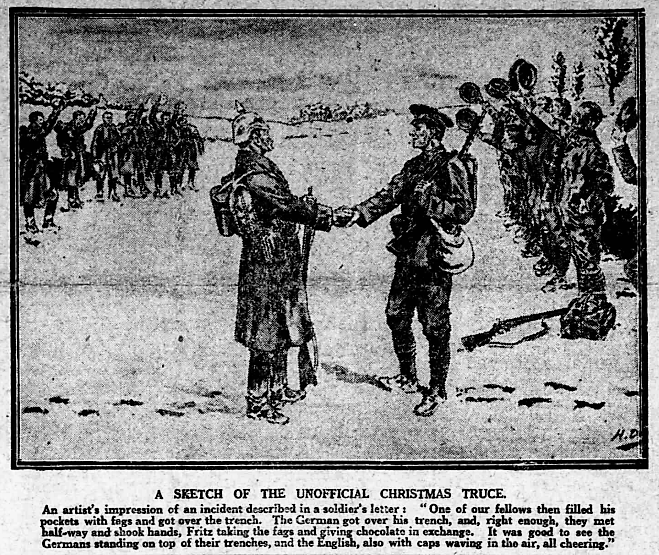
A SKETCH OF THE UNOFFICIAL CHRISTMAS TRUCE. An artist’s impression of an incident described in a soldier’s letter: “One of our fellows then filled his pockets with fags and got over the trench. The German got over his trench, and right enough, they met half-way and shook hands, Fritz taking the fags and giving […]
the Prisoners (Temporary Discharge for Ill-health) Act, 1913 – image: http://www.parliament.uk The Prisoners (Temporary Discharge for Ill-health) Act, 1913 was rushed through Parliament by Herbert Henry Asquith’s Liberal government in order to deal with the problem of hunger-striking suffragettes, who were force-fed, which led to a public outcry. The Act allowed for the […]
The phrase the cold shoulder denotes a show of intentional and marked coldness or of studied indifference. Because the two earliest instances of this phrase recorded in the Oxford English Dictionary (2nd edition – 1989) are from the Scottish novelist and poet Walter Scott (1771-1832) and do not refer to food, Robert Allen writes in Dictionary of English Phrases (2008) that […]
Executioner argues with King about cutting off Cheshire Cat’s head – illustration by John Tenniel (1820-1914) for Alice’s Adventures in Wonderland (1865) The executioner’s argument was, that you couldn’t cut off a head unless there was a body to cut it off from. The phrase a cat may look at a king means even a person of low […]



 word histories