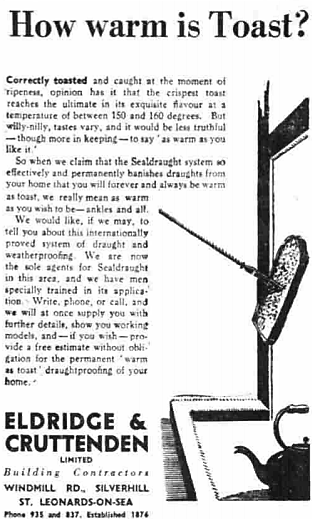
advertisement from the Hastings & St. Leonards Observer (East Sussex) 25th November 1950 How warm is Toast? Correctly toasted and caught at the moment of ripeness, opinion has it that the crispest toast reaches the ultimate in its exquisite flavour at a temperature of between 150 and 160 degrees. But willy-nilly, tastes vary, and it would less […]
‘To fight like Kilkenny cats’ means ‘to engage in a mutually destructive struggle’.—from the tale of two cats fighting until only their tails remained (early 19th century), which was originally meant to be nothing but amusing nonsense.
A New Song, sung by Mr. Champness in Harlequin’s Invasion from The Universal Magazine of Knowledge and Pleasure – March 1760 The phrase heart of oak denotes a person with a strong, courageous nature, especially a brave and loyal soldier or sailor, and a courageous or valorous spirit. Its literal meaning is the heartwood of the oak. The heartwood […]
MEANING The phrase to kick the bucket means to die—synonym: to pop one’s clogs. ORIGIN What is nowadays considered a folk etymology may well be the true origin: to kick the bucket quite possibly refers to suicide by hanging after standing on an upturned bucket. For example, the following was published in Jackson’s Oxford […]
Maconochie Brothers was a company set up in 1873 by Archibald (1854-1926) and James (1850-1895) Maconochie. (Maconochie is a surname derived from the Gaelic Macdonochie, the son of Duncan.) With food processing plants on the Isle of Dogs (London), in Lowestoft (Suffolk), in Fraserburgh (Aberdeenshire, Scotland) and other places, the company was a wholesale provision merchant and manufacturer of pickles, potted meat and […]
In this expression, the noun poke denotes a bag, a small sack. It is from Anglo-Norman and Old Northern French forms such as poke and pouque, variants of the Old French forms poche and pouche — the last of which is the origin of English pouch. (Incidentally, English pocket is from Anglo-Norman poket, pokete, diminutive forms of poke.) The expression to buy a pig in a poke simply cautions against buying or accepting […]
The phrase to let the cat out of the bag means to disclose a secret. Although it is possible that to let the cat out of the bag originally referred to some specific allusion, such as a line in a play, that has now been lost, it is probable that this phrase is simply based on the […]
Old Long Syne – broadside ballad (probably 1701) The Scots lang syne means long since, long ago. Conversely, short syne means a short time ago, recently. Especially in recalling old experiences shared with friends, auld lang syne, literally old long-ago, is used as a noun to mean the years of long ago, old times, memories of the past, and for auld lang syne is used to mean for old times’ […]
The noun cruse denotes a small earthenware vessel for liquids. It is of Germanic origin and related to words such as Dutch kroes and Swedish krus, of same meaning. The expression widow’s cruse signifies an apparently small supply that proves inexhaustible. It is an allusion to the First Book of Kings, 17. The prophet Elijah has been fed by ravens and has drunk from a […]
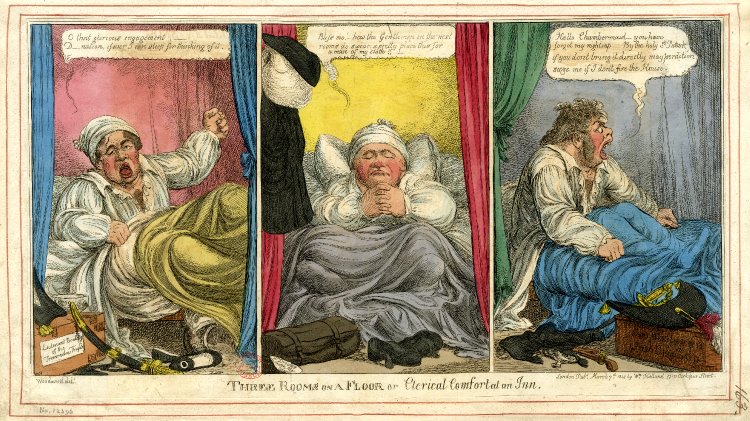
A nightcap is a cap worn in bed to keep one’s head warm. The word is first recorded in the description and valuation, made in 1378, of the articles that were in the shop of Thomas Trewe, haberdasher of London: one dozen of white caps, called “nightcappes”, was worth 2s. 3d.. The figurative […]



 word histories