The pharmaceutical firm Burroughs, Wellcome & Company was founded in London in 1880 by the American-born entrepreneurs Silas Burroughs (1846-95) and Henry Wellcome (1853-1936). They registered the name Tabloid (with capital initial) on 14th March 1884, as a trademark for concentrated drugs and medicines in tablet form. (It remains a proprietary name to this day.) The firm applied the […]
Politicians usually work with blue smoke and mirrors. What appears to be real is mostly an illusion, and what is unlikely turns out to be real. But sometimes, the blue smoke and mirrors don’t work. When you can’t produce a budget, you can’t call a news conference and pretend you did. from The News […]
The term fifth column, which translates Spanish quinta columna, denotes the enemy’s supporters in one’s own country, or a body of one’s supporters in an attacked or occupied foreign country, hence, more generally, any group of hostile or subversive infiltrators, any enemy in one’s midst—synonym: the enemy within. The Spanish Civil War (1936-39) was the […]
Decorating, not vandalizing Organized toilet-papering: Tim Koss, a senior at Green Bay East High School, gets into the spirit of homecoming by decorating the school grounds with toilet paper Thursday night. East High encourages students to toilet-paper the school instead of homes. from Green Bay Press-Gazette (Green Bay, Wisconsin) of 29th September 1995 […]
Of American-English origin, Simon says denotes a children’s game in which players must obey the leader’s instructions only if they are prefaced with the words Simon says; it also denotes the command itself. The name Simon was probably chosen for alliterative effect (Simon says). —Synonymous phrase: O’Grady says. The earliest instance of the phrase Simon […]
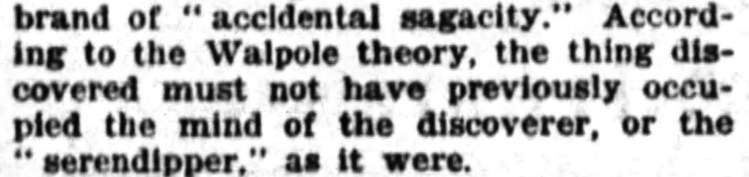
The noun serendipity denotes the faculty of making by accident discoveries that are both fortunate and unexpected. (It has been borrowed into Spanish as serendipia, into Italian as serendipità, and into French as sérendipité.) It was coined by the English writer and politician Horace Walpole (1717-97). In a letter that he wrote to his friend Horace Mann […]
The verb hash, which dates back to the mid-17th century, is from French hacher, meaning to chop, to mince, itself from the feminine noun hache, meaning an axe. (English hatchet is from the diminutive of hache, hachette.) The literal sense of the noun hash is a dish consisting of meat which has been […]
Four’s a Crowd.—A merry, irresponsible farce that dips frequently into pure crazy comedy. For this they have chosen to give Errol Flynn and Olivia de Havilland a “break” from their usual story book hero and heroine types. These two lovely young people do very well, but I cannot think that crazy comedy suits them best. […]
The informal British phrase to chance one’s arm means to undertake something although it may be dangerous or unsuccessful. Its origin is unclear. The earliest use that I have found is from How our blue-jackets are fed, an article about the “diet of the British sailor at sea” published in The Weekly Telegraph […]
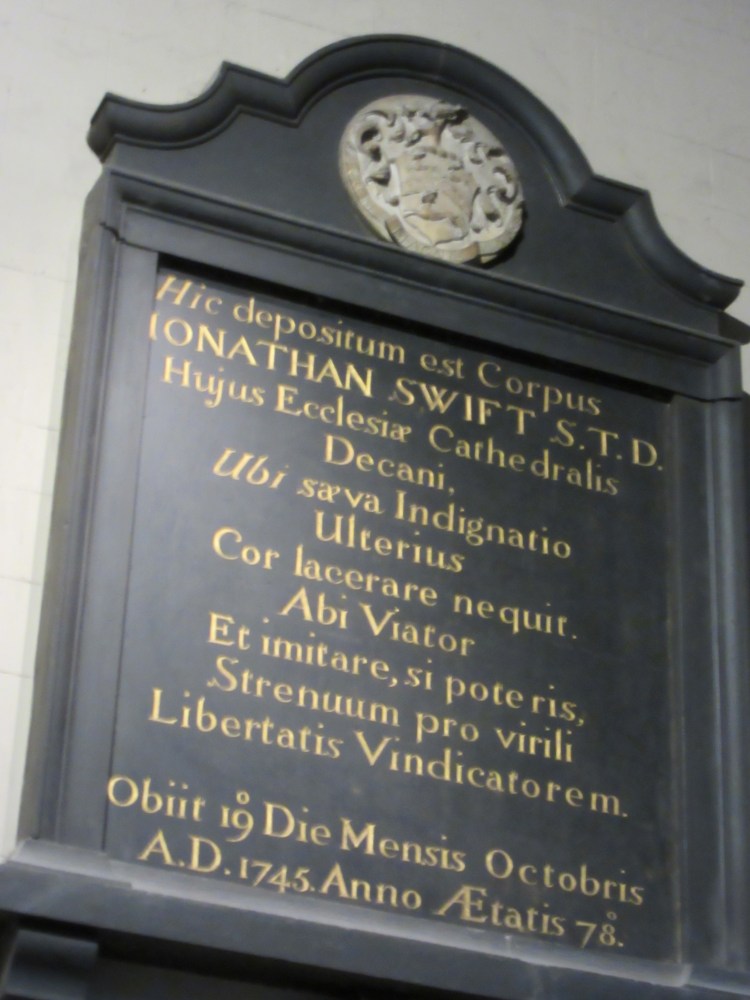
Jonathan Swift’s grave, marked by a simple brass plaque on the floor at the west end of St Patrick’s Cathedral, Dublin, is adjacent to that of his great friend in life, Stella (Esther Johnson – 1681-1728): plaques marking the graves of Jonathan Swift and Esther Johnson Latin sæva indignatio, meaning savage indignation, expresses a […]






 word histories